
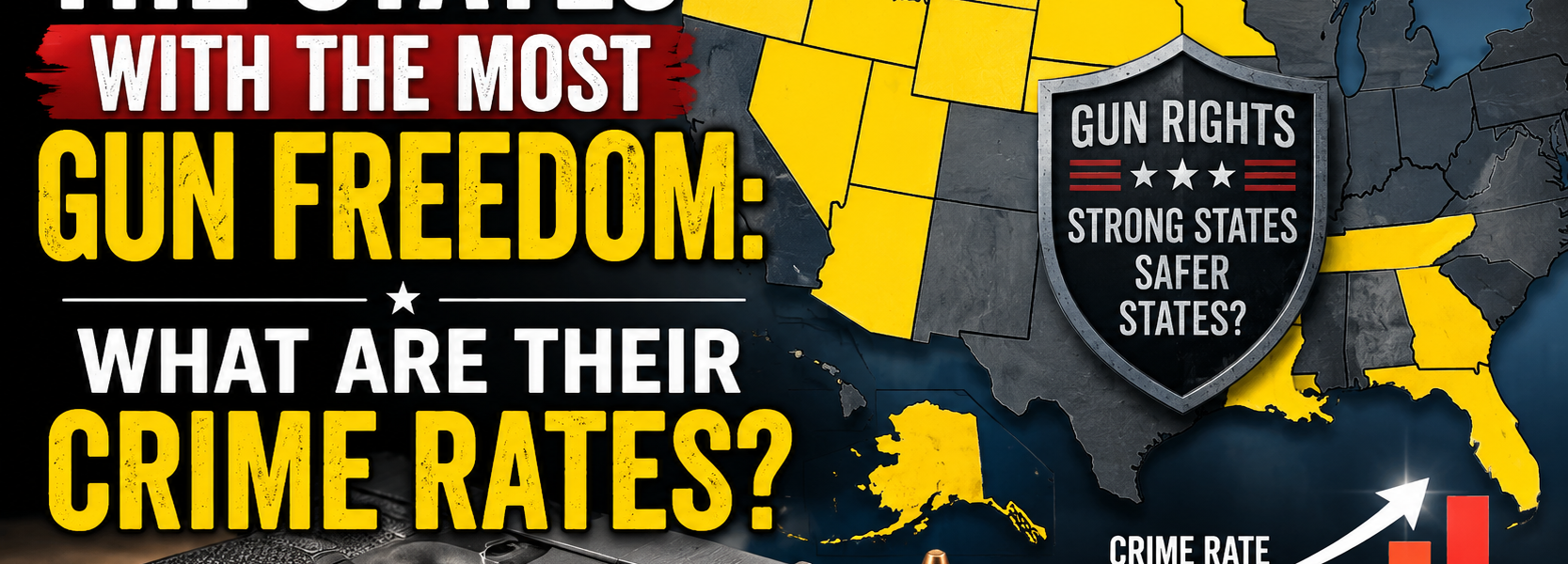
The debate over gun rights often centers on a single question: Do states with fewer restrictions on firearm ownership experience more crime?
For decades, politicians, activists, and media commentators have argued over the answer. Some insist that loosening gun laws inevitably leads to violence. Others contend that an armed citizenry deters criminals and enhances public safety. The reality, as is often the case, is more complicated.
Which States Have the Most Gun Freedom?
Organizations that rank states based on gun laws consistently place states such as Wyoming, Idaho, Montana, South Dakota, New Hampshire, West Virginia, and Arkansas near the top for gun freedom. These states generally share several characteristics:
- Constitutional carry or permitless carry laws
- Minimal restrictions on firearm purchases
- Strong protections against local gun control ordinances
- Broad recognition of self-defense rights
- Few or no magazine capacity restrictions
- Limited licensing requirements for ownership
Many of these states also have deeply rooted hunting and shooting traditions, with gun ownership viewed as a normal part of daily life rather than an unusual activity.
What Do the Crime Numbers Show?
The relationship between gun laws and crime is far from straightforward.
Some states with expansive gun rights, such as New Hampshire, Idaho, Wyoming, and South Dakota, routinely report violent crime rates below the national average. New Hampshire, in particular, has long ranked among the safest states in the nation despite having relatively permissive firearm laws.
On the other hand, some states with broad gun rights, including Arkansas and Alaska, experience violent crime rates well above the national average.
The same pattern appears among states with stricter gun laws. States such as Massachusetts and New Jersey typically report low violent crime rates. Yet other heavily regulated jurisdictions, including Illinois and the District of Columbia, continue to struggle with significant violent crime problems.
The data suggest that no simple formula exists.
More Than Just Gun Laws
Criminologists have long recognized that crime rates are influenced by numerous factors beyond firearm regulations.
Among them are:
- Poverty and economic opportunity
- Family stability
- Urbanization and population density
- Gang activity and drug trafficking
- Policing practices
- Prosecution policies
- Educational attainment
- Demographic patterns
For example, comparing sparsely populated Wyoming to densely populated New Jersey tells us little about the direct impact of gun laws alone. The social, economic, and geographic differences between the states are enormous.
Even comparisons between neighboring states can produce conflicting results.
What About Constitutional Carry?
As of 2026, more than half of U.S. states have adopted some form of constitutional carry, allowing law-abiding adults to carry concealed firearms without obtaining a permit.
Critics predicted these laws would produce dramatic increases in violence. Supporters argued they would strengthen self-defense rights without negatively affecting public safety.
Years later, researchers remain divided. Some studies report modest increases in certain categories of violent crime, while others find little measurable effect. Still others conclude that broader social conditions exert a far greater influence on crime than carry laws themselves.
What is clear is that the wave of constitutional carry legislation did not produce the nationwide crime explosion many opponents predicted.
The Bottom Line
The evidence does not support the claim that more gun freedom automatically leads to more crime. Nor does it demonstrate that strict gun control guarantees public safety.
States with the most gun freedom can be found among both the safest and the most dangerous jurisdictions in America. The same is true of states with extensive gun restrictions.
Crime is a complex social phenomenon driven by many factors. Reducing it requires more than simply passing or repealing firearm laws.
For gun owners, the debate ultimately comes down to balancing two important values: preserving a fundamental constitutional right while pursuing policies that genuinely make communities safer.