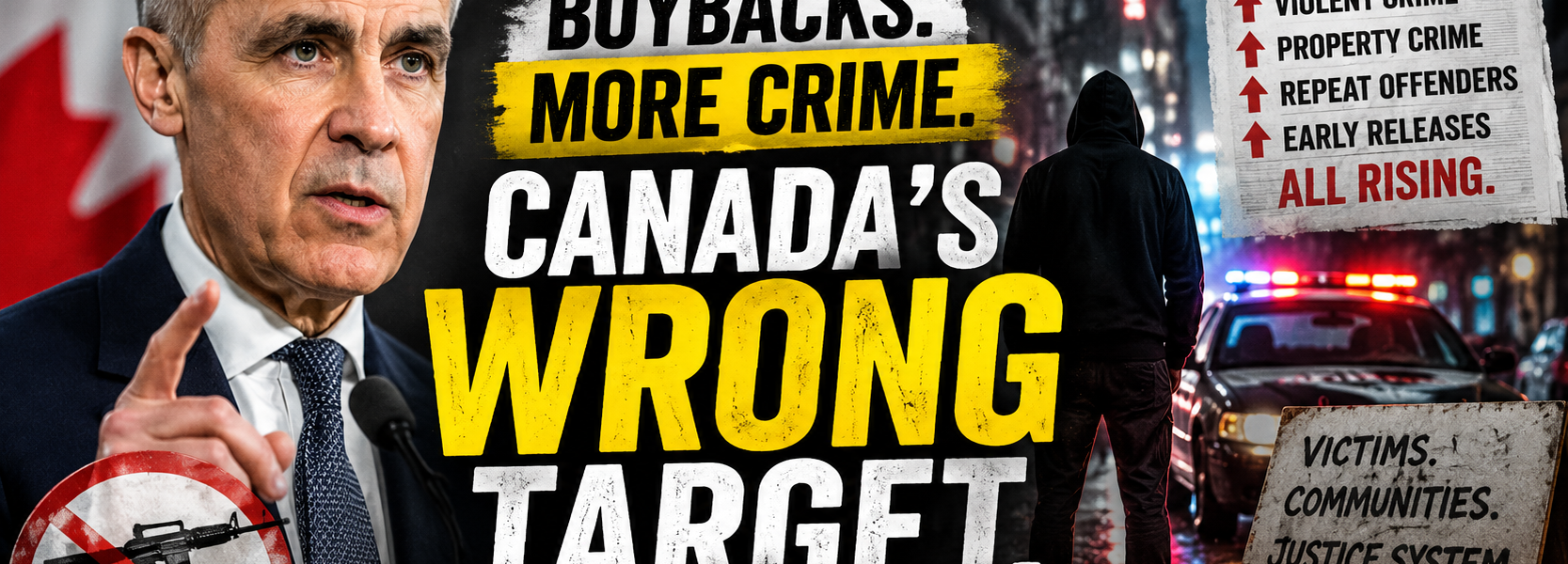
Mark Carney says his government has acted “swiftly and decisively” to fight gun crime. But after four extensions, a looming court challenge, and years of delays, “swift” looks more like stalled, and “decisive” looks anything but.
At the center of the policy is Canada’s so-called “buyback” program. It targets licensed, vetted gun owners. Not gangs. Not repeat offenders. Not the criminals actually driving violence.
That’s the contradiction.
The government is focused on confiscating firearms from people who already follow the law, while the justice system itself is struggling to hold violent offenders accountable.
A March report from the Macdonald-Laurier Institute paints a bleak picture. Violent crime is rising. Property crime is rising. Clearance rates are falling. Fewer cases end in convictions. More offenders walk free without jail time.
Canadians aren’t imagining it. They feel less safe because, statistically, they are.
And yet the policy response keeps circling back to the same target: legal gun owners.
Criminologist Gary Mauser has been blunt about it. He argues that Canada’s gun control framework is built on a flawed premise, the idea that restricting lawful ownership will meaningfully reduce crime.
The data tells a different story.
Over the past decade, violent crime in Canada has climbed significantly. At the same time, bail practices, early releases, and repeat offenders cycling through the system have become a growing concern among law enforcement.
In one widely reported case in Ontario, a father was killed during a home invasion by a suspect already out on multiple forms of release. Police didn’t just condemn the crime. They pointed directly at systemic failure.
That’s the issue policymakers keep sidestepping.
Instead, blame is often redirected outward, particularly toward the United States. The argument is that “irresponsible” American gun laws fuel Canada’s problems through smuggling.
But that explanation only goes so far.
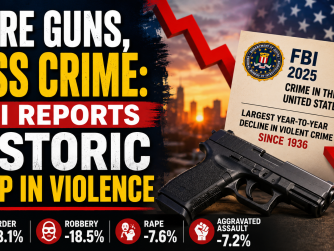
In the U.S., crime is highly concentrated in specific areas, while large portions of the country report little to no homicide at all. Meanwhile, lawful gun ownership and concealed carry have expanded in many states without triggering the widespread surge in violence that critics predicted.
That doesn’t mean the U.S. has solved crime. It hasn’t. But it complicates the narrative that more guns automatically equal more violence.
Back in Canada, the reality is harder to ignore.
If violent crime is rising…
If repeat offenders are back on the streets…
If fewer criminals are being convicted…
Then confiscating firearms from licensed owners is, at best, a distraction.
At worst, it’s policy theater.
Because the real question isn’t whether the government is acting “swiftly” or “decisively.”
It’s whether it’s acting in the right place at all.
And right now, the evidence suggests it isn’t.