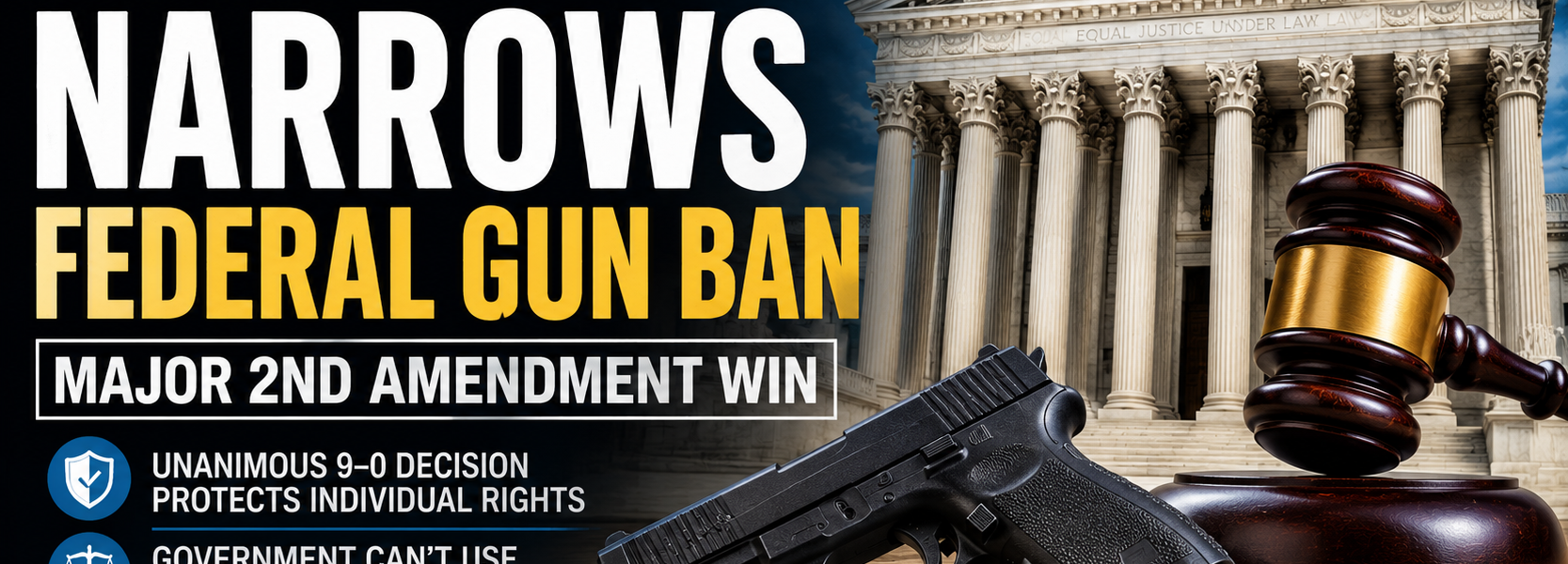
In a major Second Amendment decision, the U.S. Supreme Court has unanimously ruled that the federal government cannot automatically strip Americans of their gun rights simply because they regularly use illegal drugs, including marijuana.
The June 18 decision in U.S. v. Hemani could have far-reaching implications for millions of Americans, especially as marijuana legalization continues to spread across the country.
At the center of the case was a man named Hemani, who admitted to federal agents that he used marijuana about every other day. Authorities also found a firearm in his home. Under federal law, specifically 18 U.S.C. § 922(g)(3), that admission alone was enough to expose him to as much as 15 years in prison.
But the Supreme Court said the government went too far.
Writing for the majority, Justice Neil Gorsuch explained that the Constitution protects the right to keep and bear arms unless the government can show that restricting that right is consistent with America’s historical traditions.
The government attempted to justify the law by pointing to historical restrictions on so-called “habitual drunkards” during the nation’s early years. The Court was unconvinced.
The justices noted that historical laws dealing with chronic alcoholism were aimed at people who had become so impaired they could no longer manage their own affairs. Those laws also typically involved some form of legal process before a person’s liberty was restricted.
The modern federal gun ban, by contrast, automatically strips a person’s Second Amendment rights simply because they are considered an “unlawful user” of a controlled substance. No hearing is required. No judge must determine whether the individual is dangerous. The loss of rights happens automatically.
The Court found that to be a crucial difference.
Importantly, the justices emphasized that not every drug user poses a danger to society. While some individuals who abuse drugs may indeed be violent or dangerous, the federal law sweeps far more broadly by treating all unlawful users as if they present the same risk.
That concern was especially significant when it came to marijuana.
The Court pointed out that roughly 40 states now allow marijuana use in at least some circumstances and that the federal government itself recently downgraded marijuana from the most restrictive category of controlled substances to a lower classification recognizing accepted medical uses.
The ruling does not mean that all drug users automatically have a constitutional right to possess firearms. Instead, the Court made clear that the government may still temporarily disarm individuals who have been shown through a legal process to pose a genuine threat to others.
What the government cannot do, according to the Court, is broadly deny constitutional rights to entire categories of people without strong historical support and without showing that those individuals are actually dangerous.
For gun rights advocates, the decision represents another significant victory following the Supreme Court’s recent expansion of Second Amendment protections in cases such as New York State Rifle & Pistol Association v. Bruen and U.S. v. Rahimi.
The larger message from the Court was clear: constitutional rights are not reserved only for people the government considers ideal citizens. They are limits on government power, and those limits apply even when the person exercising those rights is unpopular or imperfect.