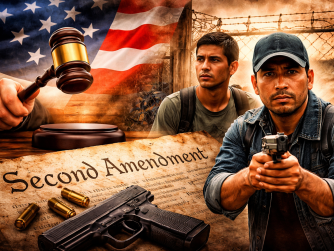

On Tuesday, January 20, the U.S. Supreme Court heard oral arguments in a major Second Amendment case asking whether states may presumptively ban licensed handgun carriers from carrying firearms onto publicly accessible private property. Opponents of the law have dubbed it the “vampire rule,” a nod to the folklore notion that vampires cannot enter a home or premises unless explicitly invited.
The metaphor is apt. But from the anti-gun side, a better comparison might have been The Invisible Man, as defenders of the law attempted to argue that the case had little to do with the Second Amendment at all. Both the NRA and the Trump administration stepped in to ensure that the constitutional issues at stake were not quietly erased.
The Bruen Backdrop
The case arises from the Supreme Court’s 2022 decision in New York State Rifle & Pistol Association v. Bruen, which struck down New York’s discretionary “may-issue” concealed-carry licensing regime. That system had effectively made lawful public carry impossible for ordinary citizens by granting government officials broad discretion to deny permits.
In Bruen, the Court reaffirmed the governing standard for Second Amendment cases first articulated in District of Columbia v. Heller:
When the Second Amendment’s plain text covers an individual’s conduct, the Constitution presumptively protects that conduct. To justify a regulation, the government must demonstrate that it is consistent with this Nation’s historical tradition of firearm regulation.
At the time Bruen was decided, a small number of states—including Hawaii—were still openly violating the right to bear arms in public by arbitrarily denying carry licenses. After losing in the Supreme Court, these states did not meaningfully comply. Instead, they passed new laws designed to replicate the same practical outcome: a right that exists on paper but is unusable in real life.
The “Vampire Rule” Workaround
The most aggressive of these workarounds was the vampire rule. Under it, licensed carry is presumptively prohibited on most private property that is open to the public—stores, restaurants, gas stations, places of worship—unless the property owner affirmatively grants permission.
This is layered on top of sweeping “sensitive place” bans covering large swaths of publicly administered property. The combined effect is devastating. Although the Court declared that individuals have a right to carry firearms in public, the reality under these laws is that people cannot engage in ordinary daily activities while exercising that right.
They cannot drop off children at school or daycare.
They cannot shop for groceries.
They cannot stop for gas or coffee.
They cannot take public transportation.
They cannot walk through a park.
They cannot attend religious services.
They cannot even enter a gun store to buy ammunition or a holster.
Defenders of the vampire rule argue that this burden is minimal because license holders can simply ask for permission. But that argument collapses under even minimal scrutiny. Like the discredited may-issue licensing schemes, the obvious goal is to make lawful carry the rare exception rather than the rule.
Concealment, Consent, and Coercion
In most states, lawful carry is concealed—either because the law requires it or because it is the most unobtrusive way to exercise the right. Many carriers do not wish to advertise their status, whether to avoid harassment from activists or to prevent being targeted by criminals.
Americans are not required to ask permission to carry Bibles, voter registration cards, political literature, NRA or ACLU membership cards, or to display political messages on clothing or vehicles. The default assumption in American life is that when someone is invited onto private property open to the public, they may bring lawful personal items with them unless the owner has clearly stated otherwise.
While property owners retain the right to exclude people or items, it has traditionally been their responsibility to make those exclusions known. The vampire rule flips that presumption on its head.
Most business owners understandably want no part in gun politics. Publicly declaring a stance—either for or against carry—invites controversy and potential boycotts. Companies that attempt neutrality, like Starbucks, have learned that gun-control activists rarely tolerate it.
Hawaii’s Outlier Status
These concerns are amplified in Hawaii, a major tourist destination that does not recognize nonresident carry permits—a separate but likely short-lived constitutional infirmity. Visitors could easily assume that licensed carry works as it does in most of the country, only to find themselves facing criminal penalties.
As the NRA explained in its friend-of-the-court brief, Hawaii’s vampire rule is a historical and modern outlier. Every other state that attempted a similar scheme—including California, Maryland, New Jersey, and New York—has seen it struck down by federal appellate courts applying Bruen’s historical test.
The idea that citizens must obtain affirmative permission to exercise a constitutional right—one exercised freely in most states—defies common sense. In Hawaii, making that mistake could cost you your firearm and your freedom.
The Court Pushes Back
Despite this, defenders of the law insisted the case was really about property rights, not the Second Amendment. Unable to satisfy Bruen’s historical standard, they argued that Hawaii’s unique history should define the default assumption about firearms on private property.
They pointed to Hawaii’s pre-statehood past as a monarchy that broadly prohibited weapons possession. But as the challengers noted, Hawaii has been a U.S. state since 1959 and is bound by the U.S. Constitution. Under Bruen, it is American—not pre-founding or indigenous—tradition that governs.
Justice Brett Kavanaugh cut through the fog: “Why are we making it complicated?” The Second Amendment covers arms, he noted, and there is no sufficient historical support for the regulation.
Justice Neil Gorsuch rejected the claim that the law had nothing to do with the Second Amendment, observing that governments are not allowed to redefine property rights in ways that infringe constitutional freedoms in other contexts.
Justice Samuel Alito sharpened the point further, comparing the vampire rule to a hypothetical law requiring patrons to obtain consent before wearing political apparel in a restaurant. Hawaii’s counsel conceded such a rule would violate the First Amendment, then retreated to the claim that the Second Amendment is different.
That argument fared no better when defenders of the law cited an explicitly racist antebellum Louisiana statute as historical support. Alito called out the irony of invoking laws designed to suppress gun rights as evidence of what the Second Amendment permits.
What Comes Next
The NRA’s historical research and the Trump administration’s participation loomed large throughout the argument. Arguing for Hawaii was Neal Katyal, former acting solicitor general under the Obama-Biden administration, who leaned heavily on these flawed historical analogies.
Whether the vampire rule will continue to haunt law-abiding gun owners remains to be seen. But if the Court applies Bruen honestly, its days are numbered.
When the opinion arrives later this year, firearm prohibitionists may find themselves hearing a familiar refrain: fangs for nothing.