
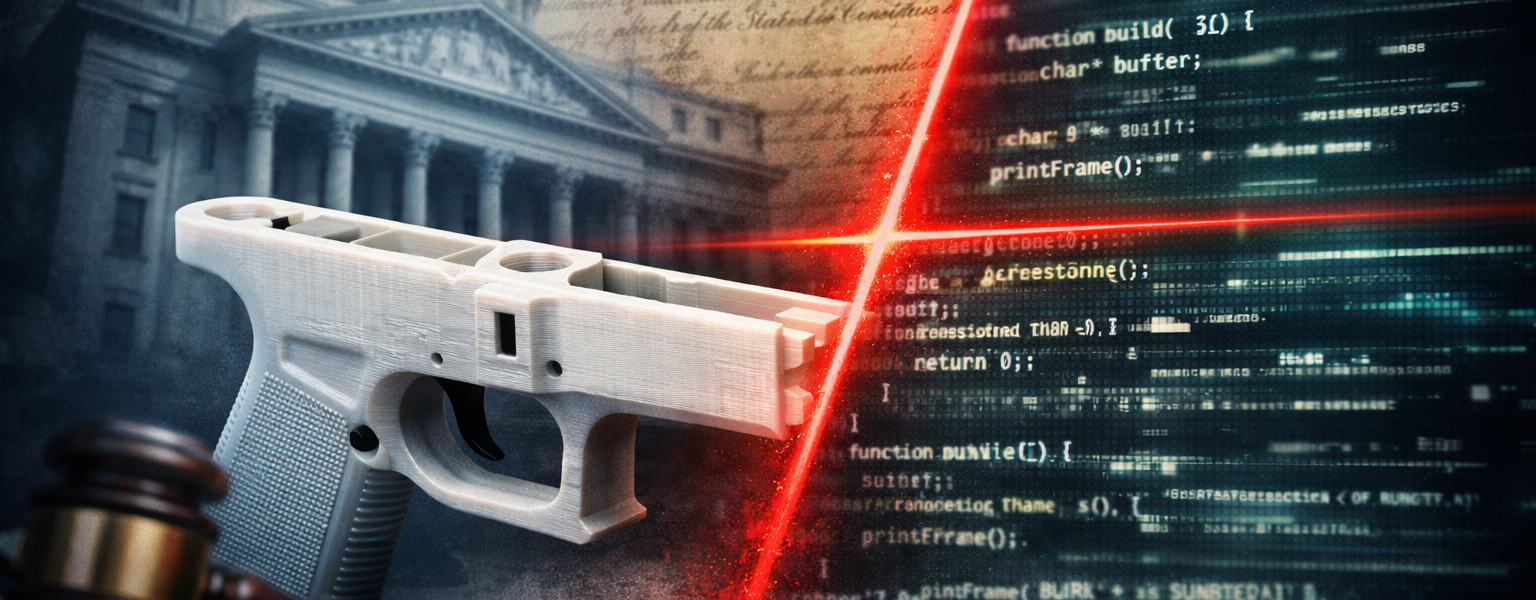
A recent federal appeals court decision has added new complexity to the long-running legal battle over 3D-printed firearms, digital gun files, and the boundaries of First Amendment protection in the digital age.
In a ruling closely watched by civil liberties advocates and gun-rights groups alike, the court held that computer code is not automatically protected speech under the First Amendment, particularly when that code has a direct functional purpose. The decision came in a case brought by Defense Distributed, a Texas-based organization that has spent more than a decade challenging state and federal restrictions on the distribution of firearm-related digital files.
The Case at Issue
The lawsuit centered on a New Jersey law that prohibits the unlicensed distribution of digital files used to manufacture firearms or firearm components using 3D printers or CNC machines. Defense Distributed argued that such files constitute protected speech and that banning their dissemination violates the First Amendment.
The appeals court disagreed—at least in part.
Rather than adopting a blanket rule that computer code is always speech, the court emphasized that context and function matter. According to the ruling, whether code qualifies for First Amendment protection depends on how expressive the code is, not merely on the fact that it is written language.
Expression vs. Function
The court drew a distinction between code that primarily communicates ideas and code that primarily enables real-world action. In this case, the judges concluded that Defense Distributed failed to sufficiently demonstrate that the specific files at issue were expressive in nature rather than purely functional.
In practical terms, the ruling suggests that code designed to directly manufacture regulated physical objects—such as firearms—may be treated differently from code intended to convey information or ideas, such as academic research, encryption discussions, or political advocacy.
Importantly, the court did not declare that gun-related code can never be protected speech. Instead, it ruled that the plaintiffs did not meet the burden of proving that their files deserved constitutional protection in this instance.
Why the Ruling Matters
The decision could have far-reaching implications beyond 3D-printed firearms.
For years, courts have wrestled with the idea that “code is speech,” particularly in cases involving encryption software, export controls, and digital publishing. This ruling reinforces a more narrow, case-by-case approach, rather than a sweeping constitutional shield for all software.
For gun-rights advocates, the outcome is a mixed result. While the ruling does not outlaw digital gun files outright, it strengthens the legal position of states seeking to regulate their distribution, especially when those files are closely tied to the production of controlled weapons.
For lawmakers and regulators, the decision provides a judicial framework that allows regulation without directly criminalizing ideas, focusing instead on the functional consequences of digital tools.
What Comes Next
Legal experts expect continued litigation in this area, particularly as 3D-printing technology becomes cheaper, faster, and more accessible. Future challenges may hinge on whether plaintiffs can better demonstrate the expressive or political nature of firearm-related code—or whether courts will increasingly view such files as tools rather than speech.
Either way, the ruling signals that the debate over guns, technology, and free expression is far from settled. As courts continue to define the limits of digital speech, the outcome will shape not only firearm policy but also the broader relationship between software, regulation, and constitutional rights.