For decades, America’s gun debate has largely revolved around a familiar set of questions. Should there be more restrictions? Fewer restrictions? What policies might reduce crime? What rights should be protected?
But in recent years, a different argument has emerged. It is less about crime statistics and legislative proposals and more about culture itself.
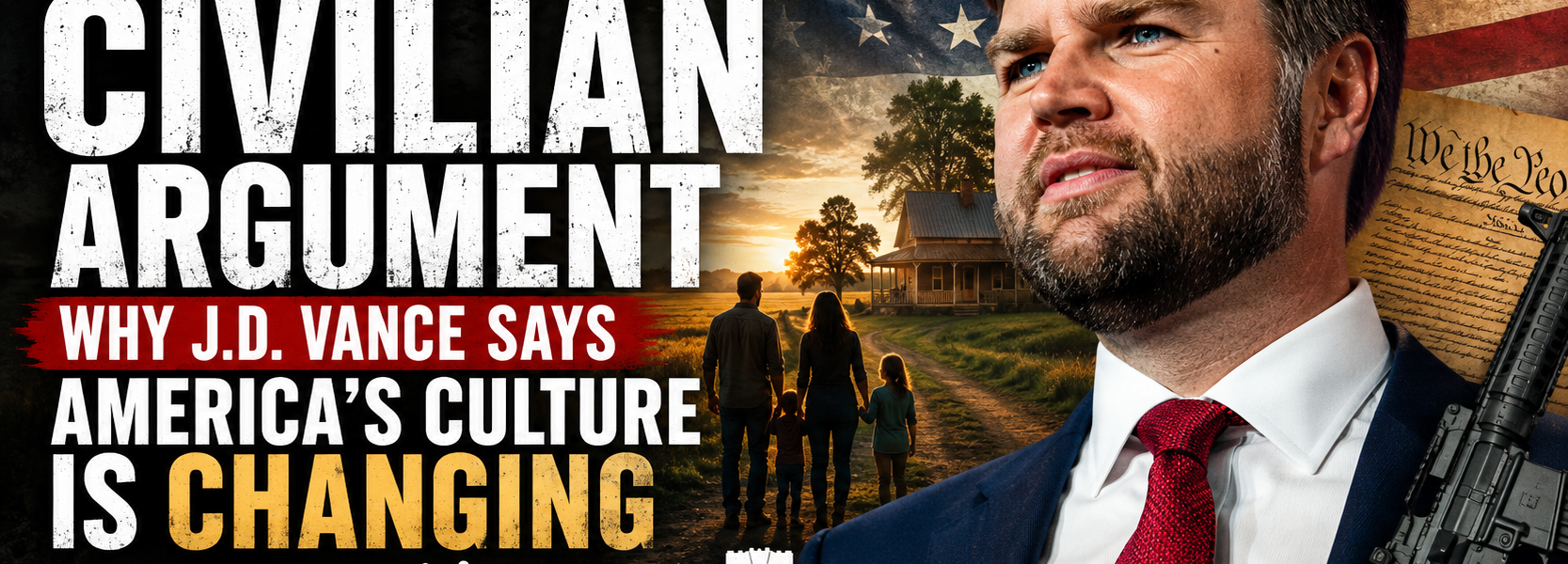
Few national politicians have articulated that perspective more clearly than J.D. Vance.
To Vance and many of his supporters, firearms are not merely tools. They represent something deeper: self-reliance, responsibility, and the belief that ordinary citizens should remain capable of protecting themselves, their families, and their communities.
That argument has become increasingly influential as America undergoes profound cultural and political changes.
The Rural Perspective
One of the most overlooked aspects of America’s gun debate is how differently rural and urban communities experience daily life.
In many major cities, police response times are measured in minutes.
In large portions of rural America, they can be measured in much longer intervals.
For families living miles outside town, self-defense is often viewed less as a political slogan and more as a practical reality.
This cultural divide helps explain why gun ownership remains deeply rooted across much of the Midwest, Appalachia, and the South.
For many rural Americans, firearms are connected to hunting, ranching, recreation, and personal security. They are often introduced to responsible firearm ownership by parents and grandparents long before they ever encounter a political debate about the Second Amendment.
Vance has repeatedly pointed to this disconnect between urban policymakers and rural communities. Many voters believe decisions affecting their lives are increasingly being made by people who neither understand nor share their experiences.
Family Protection Matters
Perhaps no argument resonates more strongly among gun owners than family protection.
While political discussions often focus on broad societal issues, most firearm owners cite a much simpler reason for ownership.
They want the ability to defend those they love.
That motivation became particularly visible during periods of civil unrest, rising crime concerns, and growing uncertainty about public safety.
Across the country, millions of first-time gun buyers entered the market.
Many were not lifelong gun enthusiasts.
Many had never previously considered owning a firearm.
Yet concerns about personal security changed their calculations.
The result was one of the largest surges in firearm purchases in modern American history.
Supporters of gun rights argue that this trend revealed something important.
When people feel uncertain, they often place greater value on self-reliance.
And self-reliance has long been one of the defining themes of American culture.
More Than a Constitutional Debate
Critics often portray gun rights advocates as being motivated solely by constitutional concerns.
Certainly, the Second Amendment remains central to the discussion.
But many gun owners view the issue through a broader cultural lens.
They see firearm ownership as connected to larger questions:
Who bears responsibility for personal safety?
How much power should individuals surrender to institutions?
What happens when citizens become entirely dependent on government protection?
These questions are not unique to conservatives, but they have become increasingly prominent within conservative politics.
Vance’s message frequently touches on this theme.
His argument is not simply that Americans have the right to own firearms.
His argument is that Americans should maintain the capacity to take responsibility for themselves.
A Changing Political Landscape
The traditional political coalitions surrounding gun rights are also shifting.
A growing number of Hispanic Americans, women, and first-time gun owners have entered the firearm community.
Many do not fit older stereotypes about gun culture.
At the same time, younger conservatives increasingly frame gun ownership as part of a broader philosophy of personal autonomy.
This evolution has transformed the Second Amendment from a niche policy issue into a major cultural dividing line.
For supporters, armed citizenship represents independence.
For opponents, it often raises concerns about public safety and violence.
The debate shows no signs of disappearing.
The Bigger Question
The future of America’s gun debate may ultimately depend less on legislation than on competing visions of citizenship itself.
One vision places greater emphasis on institutions and collective solutions.
The other places greater emphasis on individual responsibility and self-reliance.
That is why politicians like J.D. Vance continue to attract attention when discussing firearms.
The argument is no longer simply about guns.
It is about what kind of country Americans believe they are becoming.
And whether the armed citizen remains an essential part of that identity.