
If you’ve spent any time in the gun debate, you’ve probably heard wildly different numbers about defensive gun use.
One side says Americans use firearms for self-defense millions of times every year. The other says it happens only tens of thousands of times.
So who’s right?
The answer is more complicated than many headlines suggest.
Why the Estimates Vary So Much
Researchers are trying to measure something that is inherently difficult to track.
Many defensive gun uses never involve a shot being fired. In many cases, a firearm is simply displayed, and the criminal leaves. If no one is injured and police are never called, there may be no official record.
That means researchers often rely on surveys rather than police reports.
Different surveys ask different questions, use different methods, and produce very different results.
The Three Main Estimates
The National Crime Victimization Survey (NCVS)
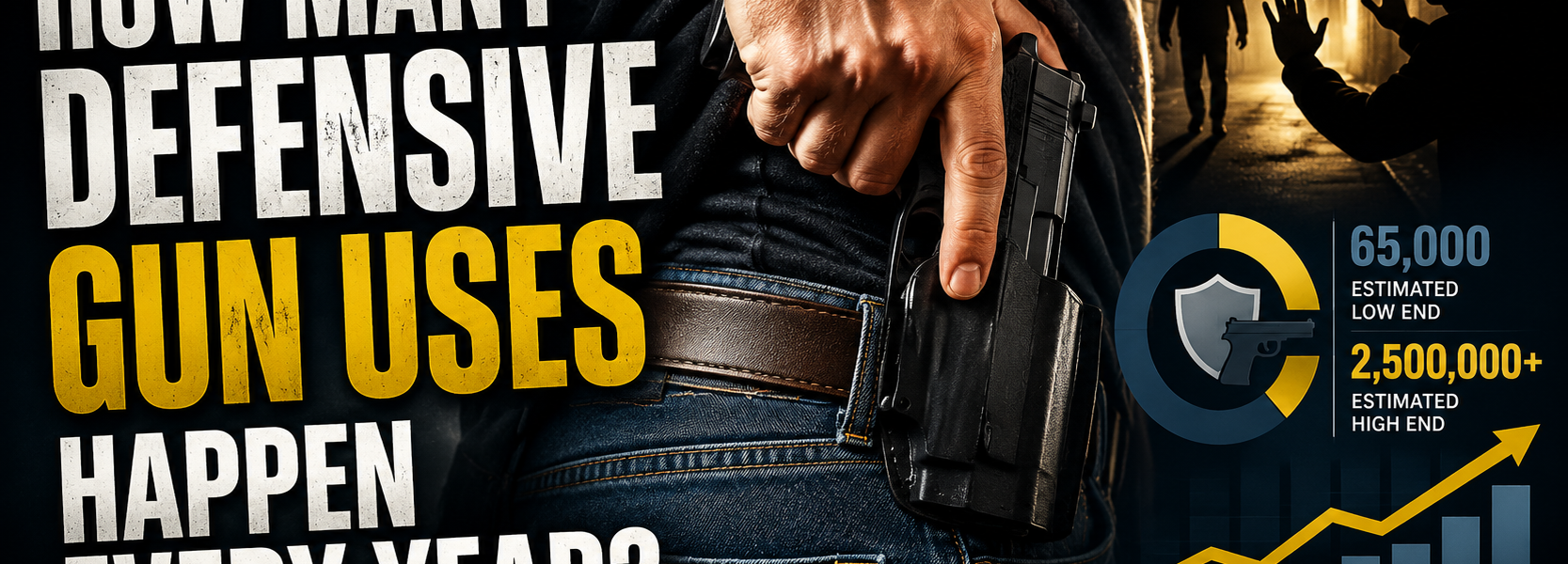
The NCVS, conducted for the U.S. Department of Justice, generally estimates roughly 65,000 to 100,000 defensive gun uses per year. It interviews crime victims directly using a structured survey process.
Gary Kleck’s Survey
Criminologist Gary Kleck’s well-known research estimated approximately 2.5 million defensive gun uses annually. His survey included incidents where a firearm was displayed but not fired and where no crime report was ever filed.
Other Surveys
Other national surveys have produced estimates that fall somewhere between those two extremes. Some researchers argue rare-event surveys tend to overestimate because of false positives, while others believe victimization surveys may miss many legitimate defensive incidents because respondents are only asked follow-up questions after reporting a qualifying crime.
Why This Debate Matters
Regardless of which estimate proves closest to reality, one point receives less attention than the headline numbers.
Not every defensive gun use ends with shots fired.
Many reported incidents involve simply presenting a firearm, causing an attacker to flee before violence escalates. Those encounters are naturally much harder to document than crimes that result in injuries, arrests, or insurance claims.
The Bottom Line
There is no universal agreement on exactly how often Americans use firearms for self-defense.
Depending on the methodology, estimates range from about 65,000 incidents per year to roughly 2.5 million. That enormous gap illustrates just how difficult it is to measure events that frequently occur without witnesses, police reports, or injuries.
What both supporters and critics of gun rights should be able to agree on is that understanding the strengths and limitations of each study is more useful than relying on a single number. Careful examination of the evidence leads to a more informed discussion than repeating statistics without context.