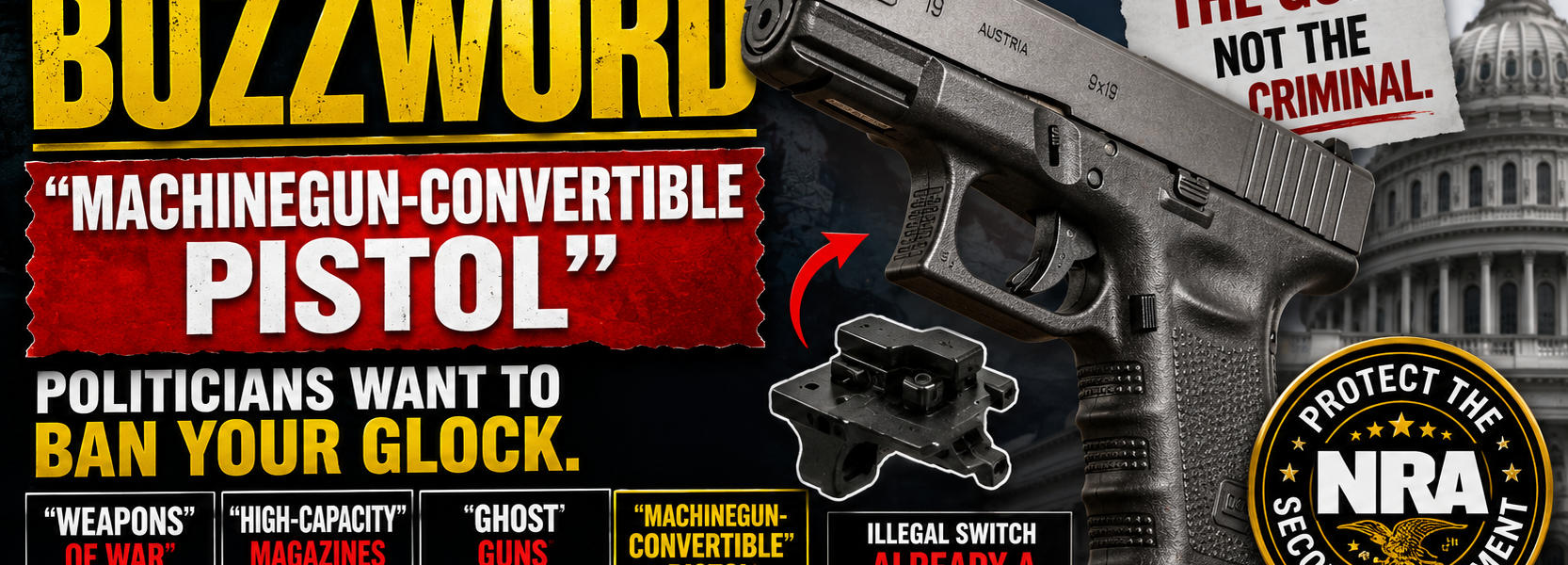
Gun control advocates have long understood that language shapes public opinion. That is why ordinary firearms are rarely described in ordinary terms. Semi-automatic rifles become “weapons of war.” Standard magazines become “high-capacity magazines.” Privately made firearms become “ghost guns.”
Now a new label is making its way through legislatures and courtrooms across the country: “machinegun-convertible pistols.”
The target is not a new type of firearm. It is the same Glock and Glock-style handgun owned by millions of law-abiding Americans.
Several states have enacted or proposed laws aimed at banning so-called machinegun-convertible pistols because criminals can illegally modify them with aftermarket conversion devices commonly known as “switches.” These devices allow a handgun to fire automatically and are already heavily restricted under federal law.
The argument from anti-gun activists is that manufacturers such as Glock should somehow bear responsibility for crimes committed by individuals who illegally modify their firearms.
That argument faces a major problem.
The conversion devices themselves are already illegal.
Federal law classifies these switches as machine guns, meaning it is generally illegal to manufacture, possess, transfer, or install them. Many states have additional laws prohibiting the devices as well.
In other words, the conduct gun control activists are complaining about is already against the law.
Yet rather than focus on prosecuting criminals who possess or use illegal conversion devices, activists and lawmakers are increasingly targeting the firearms themselves.
Baltimore and the State of Maryland recently sued Glock, arguing that the company’s handguns contribute to crime because some criminals illegally modify them. The lawsuit acknowledges that the conversions are already unlawful but nevertheless attempts to place legal responsibility on the manufacturer.
The logic is difficult to follow.
By that standard, virtually any product could be blamed for criminal misuse rather than holding the criminal accountable.
Adding to the debate is new research from the Crime Prevention Research Center, which examined the actual scope of the problem.
The organization found no evidence that law-abiding gun owners are converting their firearms into machine guns. Even supporters of these bans generally focus on criminal gangs rather than ordinary gun owners.
After conducting an extensive review of cases involving Glock-style handguns equipped with switches, researchers identified 43 murders committed in 20 attacks over a five-year period beginning in 2021.
Every one of those deaths is a tragedy.
But context matters.
Those 43 murders represent roughly 0.05 percent of all murders committed during the same period. By comparison, more than 6,100 murders were committed with knives and other cutting instruments.
The data raises an obvious question.
If these firearms are being singled out because of public safety concerns, why are lawmakers focused on banning some of the most popular handguns in America rather than aggressively prosecuting those who illegally modify them?
A recent case out of St. Louis illustrates the concern.
Police reportedly recovered multiple firearms equipped with illegal auto-sear switches after stopping a recklessly driven vehicle. Officers praised the arrest and removal of dangerous weapons from the streets.
Yet according to reports, prosecutors declined to file charges, and the suspects were released.
That contradiction is becoming increasingly familiar.
Politicians hold press conferences warning about illegal machine gun conversions while prosecutors decline to pursue cases involving the very offenders responsible for possessing them.
For Second Amendment supporters, the issue is not whether criminals should be punished for illegally converting firearms. They absolutely should.
The concern is that lawmakers are using the actions of criminals as a pretext to restrict the rights of millions of law-abiding Americans who have done nothing wrong.
As the debate continues, one thing remains clear: changing the name of a firearm does not change the Constitution. And no amount of political branding can substitute for enforcing the laws already on the books.