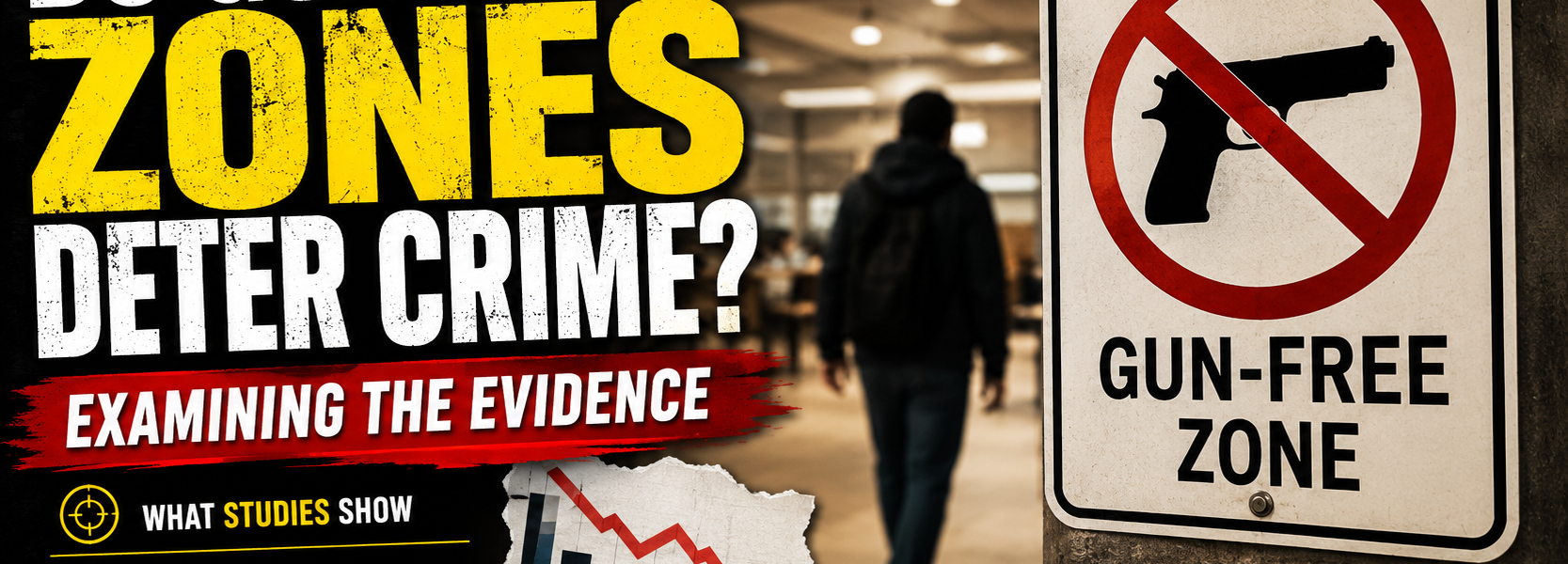
“Gun-Free Zone” signs are now common across America.
They appear outside schools, government buildings, hospitals, churches, entertainment venues, businesses, and college campuses. The message is simple: firearms are prohibited here.
Supporters argue that these restrictions reduce the likelihood of shootings, prevent ordinary conflicts from becoming deadly, and make it easier for police to identify anyone carrying a weapon as a potential threat.
Critics ask a harder question.
What happens when the only people who follow the rule are the people who were never planning to commit a crime?
Despite decades of political debate, the available research does not provide strong evidence that designating an area “gun-free” reliably prevents violent crime or mass shootings. In fact, the existing studies produce dramatically different results depending on how researchers define a gun-free zone, which incidents they count, and what period they examine.
The Numbers Are All Over the Map
One frequently cited analysis found that only 10 percent of 133 mass shootings between 2009 and 2016 occurred in locations identified as gun-free zones.
Another analysis reached almost the opposite conclusion, claiming that 97.8 percent of mass public shootings from 1998 through 2018 occurred in gun-free zones.
A more recent study examining 150 active-shooter incidents found that approximately 48 percent took place in gun-free zones.
RAND, which reviewed these competing studies, concluded that the evidence regarding the effects of gun-free zones remains inconclusive.
That range, from 10 percent to nearly 98 percent, reveals the central problem with the debate.
Researchers are often not measuring the same thing.
Some count private businesses that prohibit firearms. Others count only locations covered by specific state or federal laws. Some consider a location gun-free even when armed security or police officers are present. Others exclude incidents involving gang violence, domestic disputes, robberies, or shooters targeting specific victims.
Even the term “mass shooting” has no single national definition. Different databases use different casualty thresholds and make different decisions about whether to include domestic killings, gang-related incidents, robberies, and shootings in private homes.
RAND has warned that these conflicting definitions can substantially alter both the number of incidents counted and the apparent effects of gun laws. Researchers currently cannot produce precise, reliable estimates of how individual policies affect mass shootings.
A Sign Is Not a Security Plan
A gun-free-zone policy may discourage a lawful concealed-carry permit holder from entering with a firearm.
But a person preparing to commit murder has already decided to violate laws against homicide, assault, and unlawful firearm use. It is difficult to assume that an additional prohibition against carrying a gun onto the property will be the rule that changes his mind.
That does not mean every gun-free location is defenseless. Airports, courthouses, and certain government buildings often combine firearm restrictions with metal detectors, controlled entry points, screening procedures, trained guards, and armed law enforcement.
Those locations are not protected by a sign alone. They are protected by layers of physical security.
A private business or school that posts a prohibition without providing comparable security may create a very different situation. Law-abiding citizens are expected to disarm, while the property owner may provide little more than a decal on the door.
That distinction is frequently lost in the political debate.
There is a meaningful difference between a genuinely secured facility and a location that merely declares itself gun-free.
Criminals Do Not Need Permission
Ordinary crime also presents a challenge to the gun-free-zone theory.
Robbery, assault, carjacking, rape, and murder are already illegal. A person willing to commit those crimes is unlikely to be deterred simply because the location has an additional weapons policy.
The policy may still allow police or property owners to remove someone who is discovered carrying unlawfully. But that is not the same as proving the policy prevented the crime.
In many cases, the firearm is not discovered until after the criminal has already threatened or attacked someone.
This creates an unavoidable enforcement problem: the rule is easiest to enforce against people who openly comply with it.
Can Armed Citizens Make a Difference?
Armed citizens do not stop every shooting, nor should responsible gun owners pretend that carrying a firearm guarantees a successful outcome.
Active-shooter situations are chaotic. Even trained people can make mistakes. Police arriving at the scene may have difficulty identifying the attacker. An armed civilian must consider innocent bystanders, lines of fire, personal ability, and the possibility of being mistaken for the shooter.
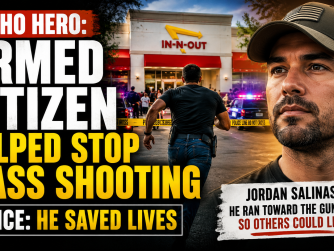
Still, documented cases show that armed citizens sometimes stop attackers.
In its report on active-shooter incidents during 2022, the FBI found that two shooters were killed by armed citizens at the scene. Other attackers were restrained or confronted by unarmed citizens.
The FBI’s broader study of active-shooter incidents from 2000 through 2013 also found numerous cases in which civilians restrained attackers before police could do so.
These events do not prove that allowing lawful carry prevents mass shootings. They do, however, undermine the claim that civilians are never capable of intervening effectively.
They also raise a legitimate question: Should a responsible, licensed citizen automatically be prohibited from defending himself and others simply because a property owner posted a sign?
What About Schools?
Schools are among the most emotionally charged parts of the debate.
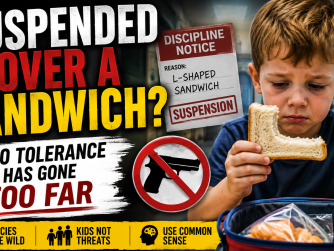
Federal law generally restricts firearm possession in school zones, although the law contains exceptions, including certain circumstances involving state-issued licenses and firearms kept on private property.
Yet the causes of school shootings extend far beyond whether firearms are prohibited on campus.
A Government Accountability Office analysis found that K-12 shootings arose from a variety of circumstances, with disputes, grievances, gang activity, accidental shootings, and school-targeted attacks all appearing in the data.
Research highlighted by the National Institute of Justice also found that many perpetrators of K-12 mass shootings obtained guns from family members, often through theft.
That suggests prevention must begin long before an attacker reaches the school entrance.
Secure firearm storage, behavioral threat assessment, reporting concerning behavior, controlled access, trained school personnel, and rapid law-enforcement response may all address risks that a gun-free-zone sign cannot.
The Secret Service has repeatedly emphasized threat assessment and early intervention as essential tools for preventing targeted school violence. Its research has found that many attackers display concerning behaviors or communicate their intentions before an attack.
The Deterrence Argument Cuts Both Ways
Supporters of gun-free zones argue that fewer guns in a location means fewer opportunities for accidents, impulsive violence, theft, or confusion during an emergency.
That concern cannot simply be dismissed.
A person carrying irresponsibly can create danger. A poorly trained individual may misunderstand a situation. A firearm left unsecured can be stolen or misused.
But critics argue that potential attackers may also prefer locations where they expect little immediate armed resistance.
Proving either deterrence theory is extremely difficult. Researchers generally cannot know how many criminals abandoned a planned attack because guns were prohibited, just as they cannot know how many chose a location because victims were expected to be unarmed.
That is one reason RAND continues to classify the evidence surrounding gun-free zones as inconclusive.
What the Evidence Actually Supports
The honest conclusion is not that every gun-free zone attracts crime.
It is also not that gun-free zones have been scientifically proven to prevent shootings.
The evidence is too inconsistent for either sweeping claim.
What can be said is that a firearm prohibition, standing alone, is not a comprehensive public-safety strategy.
A sign does not physically prevent an attacker from entering.
A policy does not stop a person who has already chosen to violate far more serious laws.
A declaration of safety is not the same as actual security.
Facilities that prohibit lawful firearm possession should therefore face a basic question: What meaningful protection are they providing in exchange for disarming the people who obey the rules?
That protection might include trained security, controlled entrances, emergency communications, threat-assessment programs, hardened access points, and rapid armed response.
Without those measures, a gun-free zone may amount to little more than a promise that the innocent will comply.
The Bottom Line
The debate over gun-free zones is often framed as a choice between safety and gun rights.
The evidence suggests the real issue is more complicated.
The available research does not establish that gun-free-zone designations reliably deter violent crime or mass shootings. Findings vary wildly, definitions are inconsistent, and the events being studied are comparatively rare and difficult to evaluate.
Meanwhile, criminals remain willing to ignore the signs, just as they ignore the laws against assault and murder.
Responsible gun owners are not wrong to question policies that remove their ability to defend themselves while offering no meaningful security in return.
A sign may communicate a rule.
It cannot stop a bullet.