
Massachusetts politicians never stop talking about “gun safety.”
They regulate magazines.
They regulate ammunition.
They regulate licensing.
They regulate storage.
They regulate transportation.
They even require residents to obtain government permission simply to own a firearm.
And yet somehow, a career violent offender who previously shot at police officers was back on the streets of Cambridge firing dozens of rounds into traffic in broad daylight.
That is the reality behind modern gun control politics.
The incident unfolded on May 11 in Cambridge, Massachusetts, when a suspect reportedly opened fire on a busy street around lunchtime, firing between 50 and 60 rounds and striking more than a dozen vehicles. Two drivers were seriously wounded.
Video of the shooting quickly spread online because it looked like something out of a collapsing city, not one of the most heavily regulated states in America.
Ironically, the attack was ultimately stopped not by gun laws, but by armed individuals.
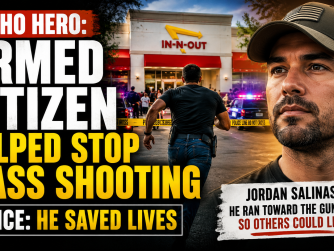
According to reports, a Massachusetts State Police trooper and an armed Marine veteran with a legal carry permit confronted the suspect and shot him before even more people could be hurt.
In other words, the exact type of armed citizen Massachusetts lawmakers spend years making life difficult for helped save innocent people.
That alone would be politically inconvenient enough.
But the deeper story is even worse.
The suspect reportedly had an astonishingly violent criminal history. According to the Boston Globe, he had previously been imprisoned for shooting at Boston police officers during a 2020 incident involving four officers. Prosecutors reportedly sought a sentence of 10 to 12 years. Instead, Judge Janet Sanders sentenced him to only five to six years, with credit for time already served.
Even more remarkably, the suspect had already been on probation during that 2020 shooting after an earlier conviction involving assault with a dangerous weapon and witness intimidation.
This was not a misunderstood first-time offender.
This was a repeat violent criminal whom prosecutors, probation officers, and police all warned was dangerous.
And yet the system still released him.
The most disturbing detail may have come from the judge herself.
NBC10 Boston later uncovered audio from the sentencing hearing in which the judge openly admitted she was “taking a chance” on the suspect despite warnings from law enforcement that he posed a danger to the community.
She then reportedly added that she simply prayed her “intuitions” were correct.
Those intuitions nearly got innocent people killed.
This is the contradiction at the center of modern progressive criminal justice policy.
The state treats peaceful gun owners like potential criminals while treating actual violent criminals like rehabilitation experiments.
Massachusetts lawmakers spent 2024 expanding already draconian gun laws through Chapter 135, a sweeping 116-page overhaul aimed largely at restricting lawful firearm ownership even further.
But none of those restrictions stopped a repeat violent offender from obtaining a gun and unleashing chaos in the middle of the day.
Instead, ordinary citizens were once again reminded of an uncomfortable truth many politicians refuse to admit:
Gun control often functions less as crime prevention and more as behavioral control over the law-abiding.
After all, criminals do not follow firearm regulations.
Violent repeat offenders do not suddenly respect magazine bans.
People willing to shoot at police officers are not deterred by additional paperwork requirements.
The people most affected by restrictive gun laws are almost always the citizens trying hardest to obey them.
Massachusetts officials frequently portray states with looser gun laws as dangerous. Yet neighboring New Hampshire, which has some of the least restrictive firearm laws in America, routinely posts lower homicide rates than Massachusetts.
That fact alone undermines much of the simplistic political narrative surrounding gun control.
The Cambridge shooting exposed something many Americans increasingly recognize:
A government willing to aggressively restrict the rights of decent people while repeatedly releasing violent offenders is not prioritizing public safety.
It is prioritizing ideology.