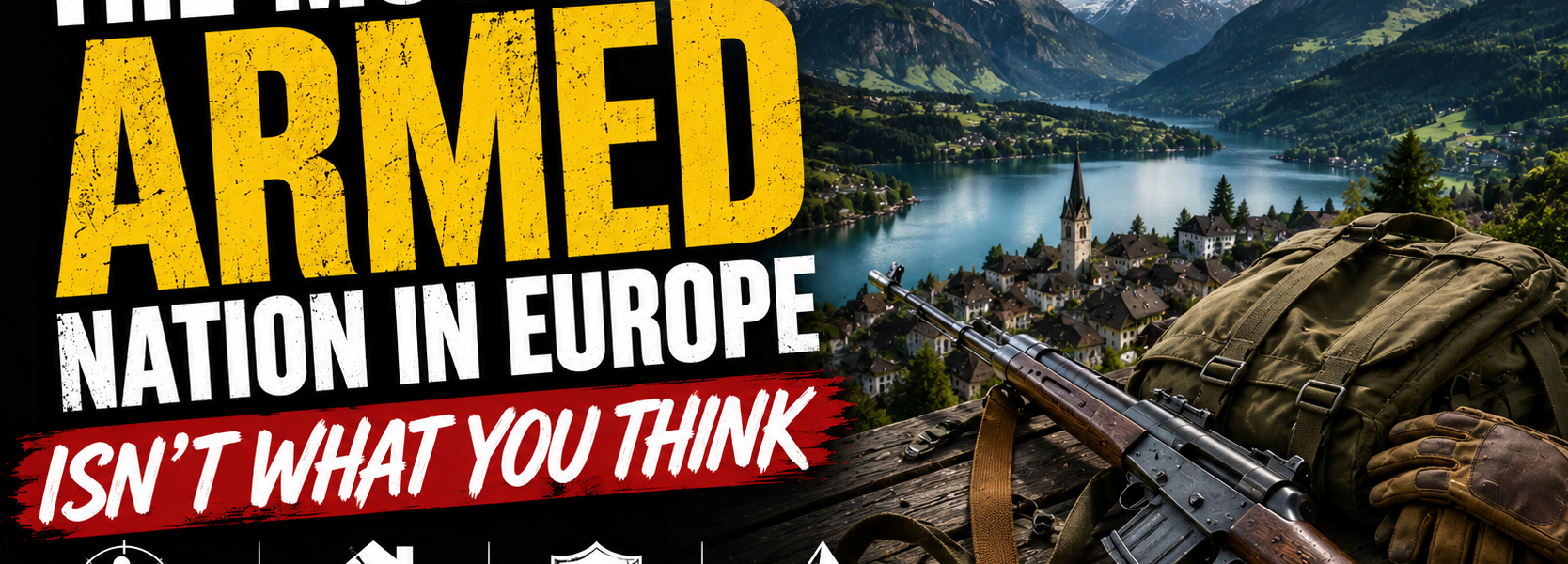
When Americans think of Europe, they usually imagine strict gun laws, heavy regulation, and governments deeply skeptical of civilian firearm ownership. But one European country completely disrupts that stereotype: Switzerland.
The same nation known for watches, skiing, and chocolate also has one of the highest civilian gun ownership rates in the developed world. Even more surprising, it consistently ranks among the safest countries on Earth.
That combination tends to confuse people. Modern political narratives often assume that widespread gun ownership inevitably produces instability and violence. Switzerland presents a much more complicated reality.
The country’s gun culture is not built around fear, rebellion, or political tribalism. It is rooted in military service, civic responsibility, and a centuries-old belief that citizens themselves play a role in defending the nation.
Unlike most European countries, Switzerland relies heavily on a militia-based defense system rather than a massive standing army. Most Swiss men undergo mandatory military training in early adulthood and remain part of the reserve force for years afterward. Historically, many even kept their service rifles at home.
To much of Europe, the idea of ordinary citizens storing military rifles in their homes sounds radical. In Switzerland, it became a normal part of national life.
That tradition goes back centuries. Switzerland’s mountainous geography and decentralized political structure encouraged local self-reliance and citizen militias long before the modern era. The Swiss identity was shaped around the idea that free citizens should be capable of defending their communities without relying entirely on centralized authority.
Today, Switzerland still maintains one of the highest rates of civilian firearm ownership in Europe. According to estimates from the Small Arms Survey, the country has roughly 27 firearms per 100 residents, far above most European nations. Firearms ownership includes military reserve rifles, hunting weapons, competition firearms, handguns, and collectibles.
What makes Switzerland especially interesting is that shooting is not treated as some fringe or suspicious activity. Competitive marksmanship is deeply woven into the culture. Local shooting festivals and competitions are common, and firearm proficiency has historically been viewed as a civic skill rather than a political statement.
Yet despite the widespread presence of firearms, Switzerland’s violent crime and homicide rates remain remarkably low.
That does not mean guns magically prevent crime, nor does it mean Switzerland can simply be copied elsewhere. The country benefits from strong social trust, low corruption, economic stability, and a population that generally takes civic obligations seriously. Firearm ownership also exists within a culture that emphasizes training, safety, and discipline from a young age.
That distinction matters.
Swiss gun culture is not built around recklessness or fantasy. Millions of citizens receive formal firearms instruction through military service or organized training. Guns are familiar tools, not mysterious objects surrounded entirely by taboo or ideology.
Switzerland also complicates the common American perception that Europe is universally anti-gun. While many European governments heavily restrict firearm ownership, Switzerland has repeatedly resisted attempts to dismantle its traditions entirely. Even when the country adopted some EU-aligned firearm regulations in 2019, it remained substantially more gun-friendly than most of the continent.
None of this means Switzerland is simply “America in the Alps.” The cultures, demographics, laws, and histories are entirely different. But Switzerland does expose the weakness of simplistic arguments that reduce gun violence to a single variable.
The Swiss model suggests that culture, training, social cohesion, and civic responsibility matter just as much as legislation.
For centuries, Switzerland has maintained something much of the modern world claims cannot exist: a heavily armed civilian population living in one of the safest societies on Earth. That alone makes it one of the most fascinating gun cultures anywhere in the world.