
For decades, Second Amendment law was often treated as a constitutional afterthought. Today, it has become one of the most complex and aggressively contested areas of American jurisprudence.
That complexity exploded after the Supreme Court’s landmark decision in New York State Rifle & Pistol Association v. Bruen, which fundamentally changed how courts evaluate gun laws. Instead of balancing vague public-interest tests against constitutional rights, courts are now required to examine the actual text, history, and tradition surrounding the Second Amendment.
In theory, this was supposed to bring discipline and constitutional consistency back into firearms law.
In practice, it has created a legal battlefield where historical interpretation itself has become weaponized.
The New Front in the Gun Debate
Under the Bruen framework, governments defending gun restrictions must demonstrate that similar regulations existed during the founding era or are consistent with America’s historical tradition of firearm regulation.
That sounds straightforward until one realizes how difficult and specialized such historical analysis truly is.
Modern Second Amendment litigation now requires expertise not only in constitutional law, but in:
- Colonial legal history
- Reconstruction-era statutes
- Historical linguistic interpretation
- Common law traditions
- Archival research
- Administrative law
- Federal and state firearms regulations
- Ever-changing appellate precedent
Even experienced attorneys struggle to navigate the enormous volume of statutes, judicial opinions, agency rules, and historical documents involved.
Into that chaos enters artificial intelligence.
AI Is Accelerating Both Truth and Error
Artificial intelligence is rapidly becoming integrated into legal research and drafting. In some ways, this is revolutionary. Massive databases of statutes, case law, historical texts, and legal opinions can now be processed in seconds rather than weeks.
But there is a major problem.
AI systems are only as reliable as the information they absorb.
If flawed legal scholarship, inaccurate citations, or historically misleading claims enter the system, AI can replicate and amplify those errors at extraordinary speed.
This is no longer hypothetical.
Courts across the country have already dealt with attorneys submitting fabricated case citations generated by AI systems. Some lawyers have faced sanctions after citing cases that simply did not exist. More troubling still, inaccurate historical claims are increasingly finding their way into judicial opinions themselves.
Once an error enters published legal precedent, it begins to acquire authority through repetition.
And repetition is exactly how AI systems learn.
The Danger of Manufactured History
The Second Amendment debate has always involved competing interpretations of history. But there is an important distinction between honest disagreement and the deliberate stretching of historical evidence to support modern policy goals.
Critics of expansive gun rights have increasingly relied on obscure, geographically isolated, or contextually distorted historical laws to justify sweeping modern firearm restrictions.
This becomes especially significant after Bruen because the Supreme Court explicitly instructed courts to look for historical analogues.
If those analogues are inaccurately presented, the entire constitutional analysis becomes corrupted.
A recent example highlighted by attorney Stephen P. Halbrook demonstrates exactly how dangerous this can become.
The “Sensitive Place” Problem
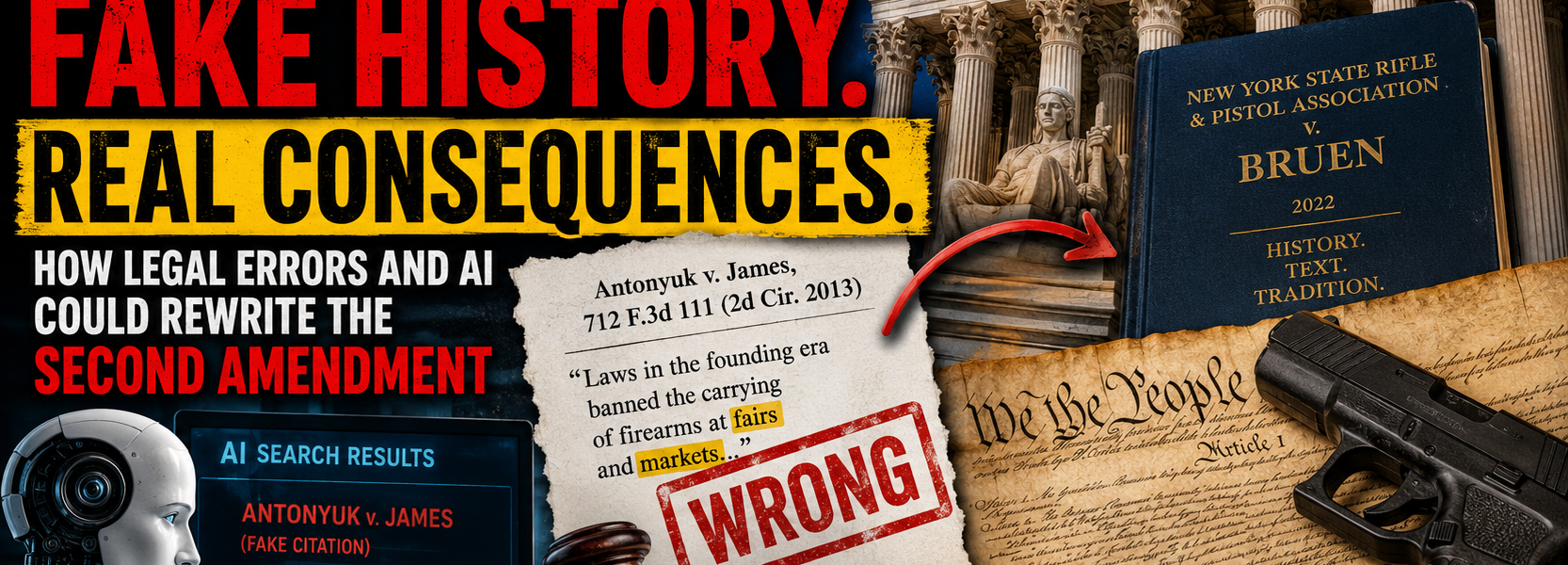
In his article examining the spread of erroneous historical citations in gun litigation, Halbrook focuses on the Second Circuit’s decision in Antonyuk v. James.
The case involved New York’s broad restrictions on carrying firearms in so-called “sensitive places.”
To uphold these restrictions under Bruen, the court cited alleged founding-era bans on carrying firearms at fairs and markets in Virginia and North Carolina.
According to Halbrook’s examination of the primary historical sources, however, those laws did not prohibit ordinary firearm carry at such locations. Instead, they addressed the offense of going armed “to the terror of the people,” a far narrower concept tied to threatening or terroristic conduct rather than mere possession.
Halbrook further argues that the court relied on a privately published source while overlooking actual North Carolina law entirely.
If accurate, the implications are enormous.
Because once one appellate court adopts flawed historical analysis, other courts begin citing it as established precedent. The error spreads outward through judicial opinions, academic papers, legal briefs, and eventually AI training data itself.
Bad history becomes “accepted history.”
And accepted history becomes the foundation for constitutional rulings.
A Constitutional Right Built on Faulty Scholarship
The concern here is larger than a single citation dispute.
The modern legal system increasingly operates through interconnected citation networks. Judges rely on prior opinions. Scholars rely on prior scholarship. AI systems rely on the total accumulated body of published information.
If foundational errors enter that chain, they can quietly reshape constitutional interpretation for years before anyone notices.
This is particularly dangerous in Second Amendment law because courts are now explicitly tasked with historical reconstruction.
A fabricated or distorted historical tradition can be used to justify virtually any modern restriction.
Today it may involve “sensitive places.”
Tomorrow it could involve magazine bans, firearm registries, ammunition restrictions, or broad carry prohibitions.
The stakes are enormous because constitutional rights often hinge on historical interpretation.
Why Accuracy Matters More Than Ever
Supporters of the Second Amendment have long argued that gun rights face cultural hostility from large segments of academia, media, and political institutions.
Whether one agrees with that assessment or not, it is undeniable that firearms law receives extraordinary scrutiny and emotional pressure compared to many other constitutional issues.
High-profile crimes, public fear, political polarization, and media narratives all influence the environment in which courts operate.
That makes rigorous historical accuracy even more essential.
Careless scholarship is dangerous enough.
Deliberate manipulation is worse.
And AI has the potential to accelerate both.
The future of constitutional law may increasingly depend on whether courts, scholars, and attorneys can distinguish genuine historical tradition from repeated historical fiction.
Because once falsehood is embedded deeply enough into the legal system, it no longer looks like falsehood.
It looks like precedent.