For years, Americans have focused almost exclusively on the political fight over the Second Amendment. The battles have been public, loud, and obvious: assault weapon bans, magazine restrictions, red flag laws, and endless debates on cable news.
But while gun owners were watching Washington, another front quietly opened behind the scenes.
Not in Congress.
Not in the courts.
In boardrooms.
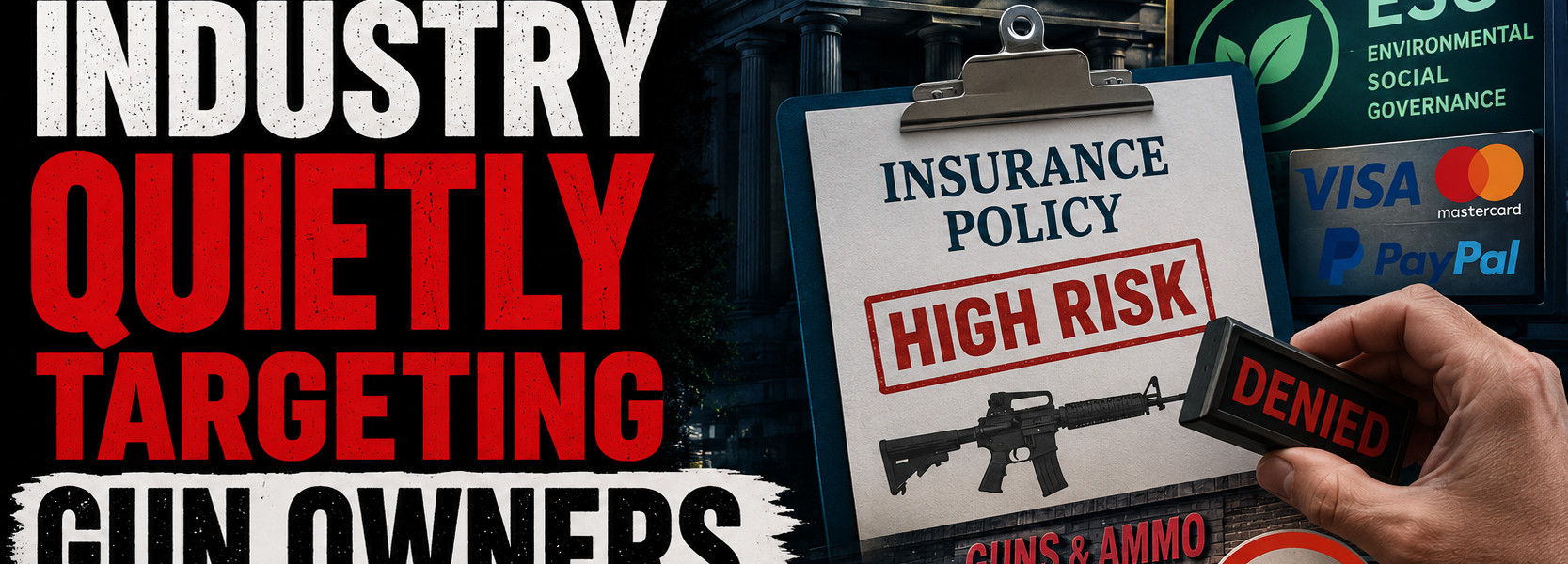
Increasingly, banks, insurers, payment processors, and ESG-driven financial institutions are treating firearm ownership itself as a form of reputational risk. The result is something many gun rights advocates now describe as “corporate gun control” — an effort to restrict the firearms industry not through legislation, but through financial pressure.
And because it happens quietly, many Americans do not even realize it is occurring.
After major mass shootings over the past decade, several large financial institutions announced policies limiting their relationships with firearm manufacturers or retailers. Some banks restricted lending to companies involved in modern sporting rifles. Others introduced additional scrutiny for firearm-related transactions. Insurance providers began reevaluating risk categories tied to gun businesses and shooting events.
The justification is almost always framed the same way:
“Risk management.”
But critics argue the real goal is cultural and political pressure.
The strategy is simple: if lawmakers cannot outlaw firearms outright, corporations can make ownership, manufacturing, distribution, and commerce increasingly difficult. A gun company denied loans, insurance coverage, payment processing, or merchant services becomes harder to operate even if its products remain perfectly legal.
This is why many in the firearms community increasingly view ESG investing as more than a harmless corporate trend.
ESG — Environmental, Social, and Governance scoring — was originally marketed as a way to encourage ethical investing. But in practice, many conservatives argue it has evolved into a political compliance system where industries viewed as socially controversial are financially penalized.
Fossil fuels were among the first targets.
Firearms followed closely behind.
Under this framework, gun manufacturers are often categorized alongside industries deemed “socially harmful,” regardless of constitutional protections or lawful use by millions of Americans.
And the effects are real.
Some firearm retailers have reported difficulties obtaining insurance coverage at affordable rates. Payment processors have occasionally flagged firearm-related purchases for additional monitoring. Certain banks have publicly distanced themselves from gun manufacturers after activist pressure campaigns.
Even entirely lawful businesses can suddenly find themselves treated like liabilities.
For many Americans, this raises a larger concern that extends far beyond guns.
Who decides which constitutional rights are acceptable?
Because once corporations begin acting as ideological gatekeepers, the implications spread quickly. If financial institutions can pressure lawful firearm commerce today, critics ask what stops similar pressure campaigns against speech platforms, religious organizations, political groups, or controversial causes tomorrow?
That concern intensified after revelations that financial institutions and federal agencies had discussed monitoring certain transaction patterns tied to firearms or outdoor retailers. While defenders argue such systems are designed to detect criminal activity, opponents fear they normalize the idea that ordinary gun ownership itself should trigger suspicion.
To many Second Amendment advocates, that is the real issue.
Not merely whether someone can still buy a firearm today, but whether lawful gun ownership is gradually being transformed into something corporations portray as socially abnormal, financially dangerous, or culturally unacceptable.
This is not the kind of gun control Americans traditionally debate.
There are no Senate hearings.
No dramatic presidential speeches.
No sweeping federal bans.
Instead, there are algorithms.
Risk departments.
Insurance underwriters.
Merchant category codes.
Quiet internal policies.
And perhaps that is precisely why this trend matters.
Because rights do not disappear only through direct prohibition. Sometimes they erode through friction. Through stigma. Through institutional pressure designed to make exercising a right increasingly inconvenient, expensive, or socially costly.
The Second Amendment was written to protect a constitutional liberty from government infringement.
The modern question may be whether Americans are prepared for a future where that pressure comes not only from government, but from corporations powerful enough to shape public behavior without ever passing a single law.