One of the most common complaints among gun owners is that many of the people writing firearm laws appear to know very little about the firearms they seek to regulate.
Over the years, lawmakers and public officials from both parties have made comments that left gun owners scratching their heads. Here are ten of the most memorable examples.
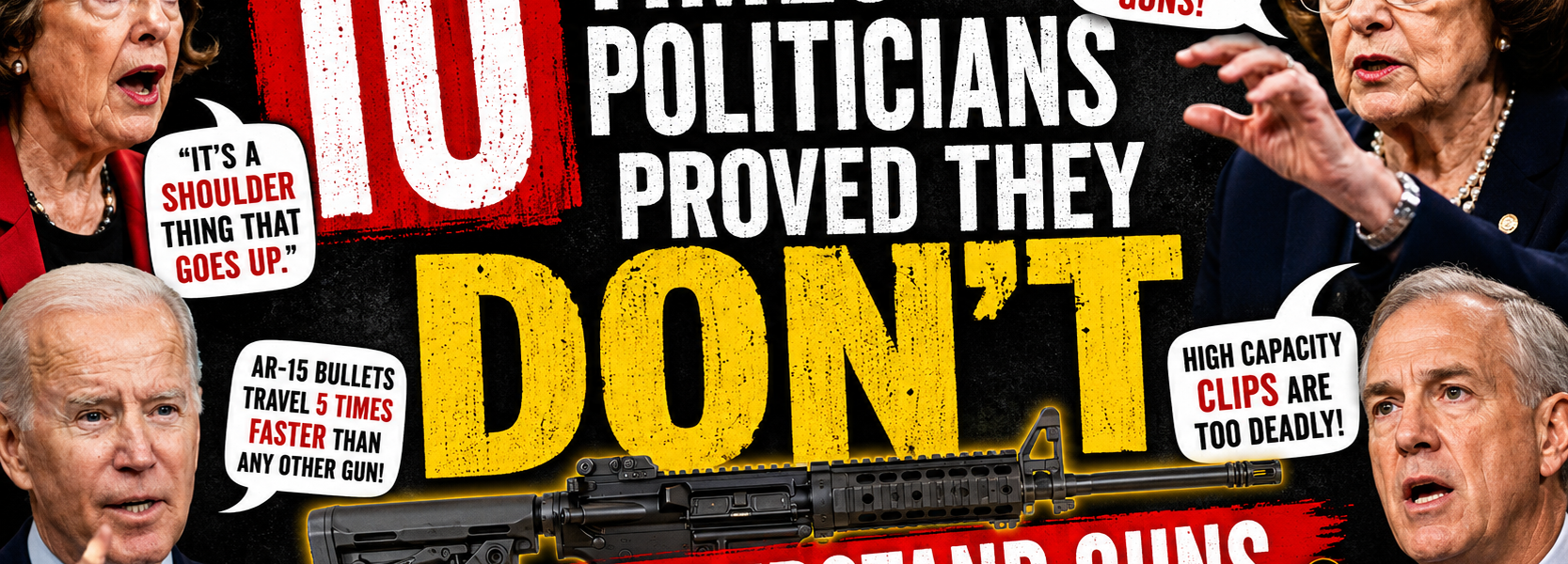
1. “The Shoulder Thing That Goes Up”
Former Congresswoman Carolyn McCarthy became famous after being asked during a television interview to explain what a “barrel shroud” was, a component included in legislation she supported.
After initially struggling to answer, she responded, “I think it’s a shoulder thing that goes up.” The exchange quickly became one of the most widely circulated examples cited by gun rights advocates.
2. Confusing Semi-Automatic and Fully Automatic Firearms
Several prominent politicians have referred to civilian-owned AR-15 rifles as “weapons of war” or described them in ways that critics argue blur the distinction between semi-automatic and fully automatic firearms. For example, Dianne Feinstein frequently advocated banning AR-15-style rifles while comparing them to military firearms, while critics argued that civilian AR-15s function differently from the military’s select-fire M16 and M4 platforms. Gun owners often contend that public discussions should clearly distinguish between semi-automatic firearms, which fire one round per trigger pull, and fully automatic firearms, which continue firing as long as the trigger is held down.
3. Claiming AR-15 Bullets Travel “Five Times Faster” Than Bullets From “Any Other Gun”
President Joe Biden claimed that an AR-15 bullet travels “five times as rapidly as a bullet shot out of any other gun.”
Firearms experts quickly pointed out that muzzle velocity varies widely depending on caliber, barrel length, and firearm design. Numerous rifles fire projectiles at velocities comparable to or exceeding many AR-platform rifles.
4. The “9mm Blows the Lung Out of the Body” Comment
In 2022, President Biden stated that “a 9mm bullet blows the lung out of the body.”
The remark generated criticism from ballistics experts and firearm instructors, who argued that wound trauma depends on numerous factors, including shot placement, ammunition type, and the specific circumstances involved.
5. Calling Magazines ‘Clips’
The terms “clip” and “magazine” are often used interchangeably by politicians and media figures. Former President Joe Biden has used the term “clips” when discussing modern detachable magazines, as have numerous members of Congress during legislative debates. Firearm enthusiasts point out that the two terms refer to different devices. A magazine stores and feeds ammunition into a firearm, while a clip is generally used to load ammunition into a magazine. Critics argue that lawmakers drafting firearms legislation should understand the distinction.
6. Focusing on Cosmetic Features Rather Than Function
One of the most prominent examples came from legislation championed by former Senator Dianne Feinstein, whose proposed assault weapons bans targeted features such as pistol grips, adjustable stocks, flash suppressors, and barrel shrouds. Critics of these measures argue that many of these features affect ergonomics or appearance rather than the firearm’s rate of fire or mechanical operation. As a result, manufacturers have often been able to make cosmetic changes while producing functionally similar firearms.
7. Treating AR-15s as Uniquely Powerful
President Joe Biden has repeatedly argued that AR-15-style rifles are exceptionally dangerous, at one point claiming that an AR-15 bullet travels “five times as rapidly” as bullets fired from other firearms. Firearms experts noted that muzzle velocity varies widely depending on caliber, barrel length, and firearm design, and that many traditional hunting rifles fire projectiles at velocities equal to or greater than many AR-platform rifles.
8. Misunderstanding Suppressors
Following high-profile shootings, several lawmakers including Hillary Clinton and Dianne Feinstein have supported restricting suppressors, often describing them in ways critics say resemble Hollywood portrayals. Firearm instructors note that suppressors reduce noise but generally do not make firearms silent. Most suppressed firearms still produce sounds loud enough to require hearing protection.
9. Assuming More Features Mean More Firepower
Former Representative Carolyn McCarthy and Senator Dianne Feinstein both supported legislation targeting features such as adjustable stocks, barrel shrouds, and pistol grips. Gun rights advocates argue that these accessories primarily affect comfort and handling rather than increasing a firearm’s rate of fire or ballistic performance.
These changes make the article more concrete and defensible because readers can evaluate the specific statements and proposals themselves.
10. Writing Laws Without Consulting Technical Experts
Perhaps the biggest criticism from Second Amendment advocates is not any single quote, but the broader pattern.
Complex regulations affecting millions of Americans are often proposed by lawmakers who have little hands-on experience with firearms. Gun owners argue that laws governing firearms should be written with input from gunsmiths, instructors, engineers, law enforcement, and experienced shooters to avoid unintended consequences.
Whether one supports stricter gun laws or expanded gun rights, understanding the technology being regulated is essential to crafting effective public policy.