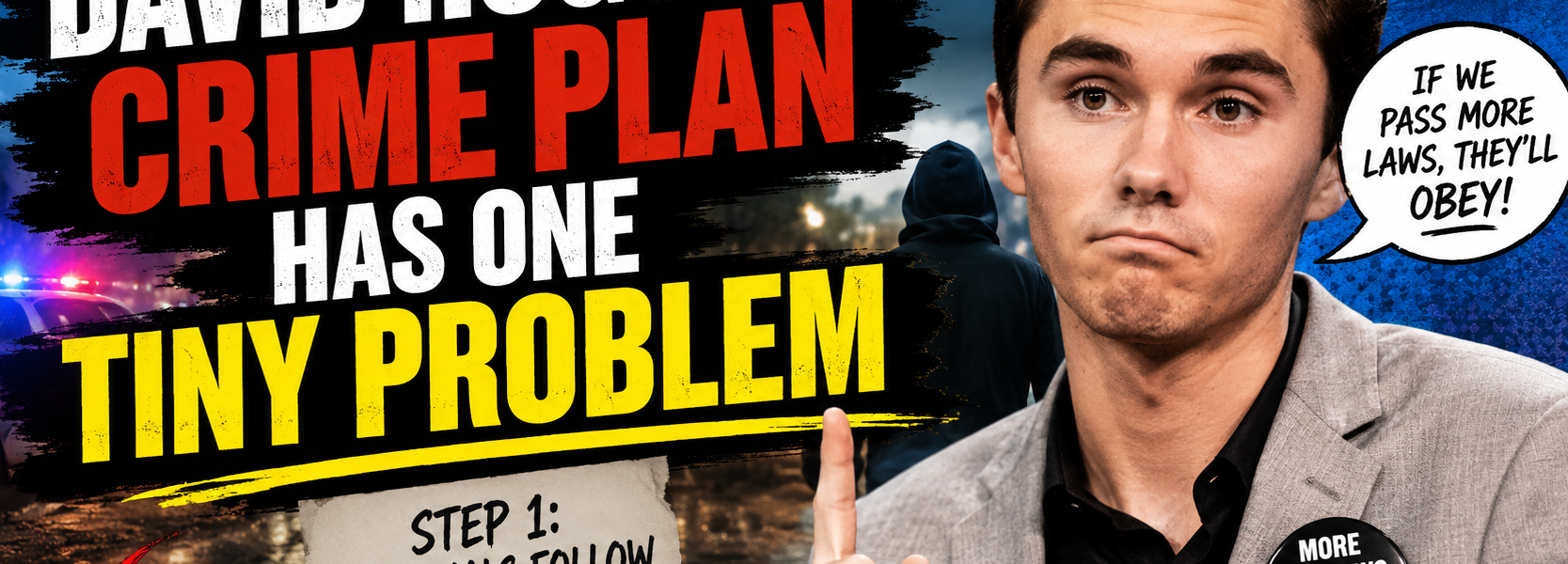
For years, David Hogg has promoted a simple theory of crime prevention: pass more gun laws, and criminals will somehow become more law-abiding.
That’s not exactly how he phrases it, of course.
Hogg typically calls for measures such as assault weapon bans, magazine restrictions, waiting periods, and expanded background checks. The theory is that if enough regulations are placed between Americans and firearms, violent crime will decline.
There’s just one small problem.
The people committing violent crimes are already ignoring laws.
A gang member carrying an illegal firearm doesn’t wake up each morning wondering whether Congress recently adjusted a magazine-capacity limit.
A convicted felon possessing a stolen handgun has already blown past several criminal statutes before breakfast.
A home invader is unlikely to pause in the middle of a burglary and think:
“Wait a minute. Did David Hogg just advocate another firearms restriction? I guess I’d better turn myself in.”
Yet every time a tragedy occurs, the proposed solution somehow remains the same.
More laws.
More regulations.
More restrictions.
The assumption behind the argument appears to be that criminals, who routinely ignore laws against murder, assault, robbery, drug trafficking, car theft, and illegal gun possession, will finally discover a deep respect for government authority when a new gun-control bill is signed.
It’s a remarkable level of optimism.
In fact, if Hogg’s theory is correct, America may be wasting billions on law enforcement.
Why not simply pass a law requiring criminals to stop committing crimes?
Perhaps Congress could ban armed robbery.
Maybe outlaw gang violence.
We could even make murder illegal.
Surely that would solve the problem.
The irony is that Hogg’s proposals often leave untouched the people most likely to ignore the law while creating new restrictions for people who already obey it.
The law-abiding gun owner who passes a background check, stores firearms safely, and has never committed a violent crime faces additional hurdles.
The criminal? He’s already operating outside the system.
That doesn’t mean every gun-control proposal is automatically ineffective. Reasonable people can debate specific policies.
But the criticism aimed at Hogg has always been straightforward: his preferred solutions often seem designed around controlling people who follow rules rather than people who don’t.
For someone who talks constantly about stopping criminals, his plans still depend heavily on criminals suddenly deciding they love regulations as much as he does.
And if that day ever comes, Congress should immediately pass a law requiring everyone to eat vegetables, exercise daily, and stop lying on the internet.
The compliance rate should be tremendous.