Every so often, a piece of gun legislation comes along that doesn’t just raise questions. It raises eyebrows.
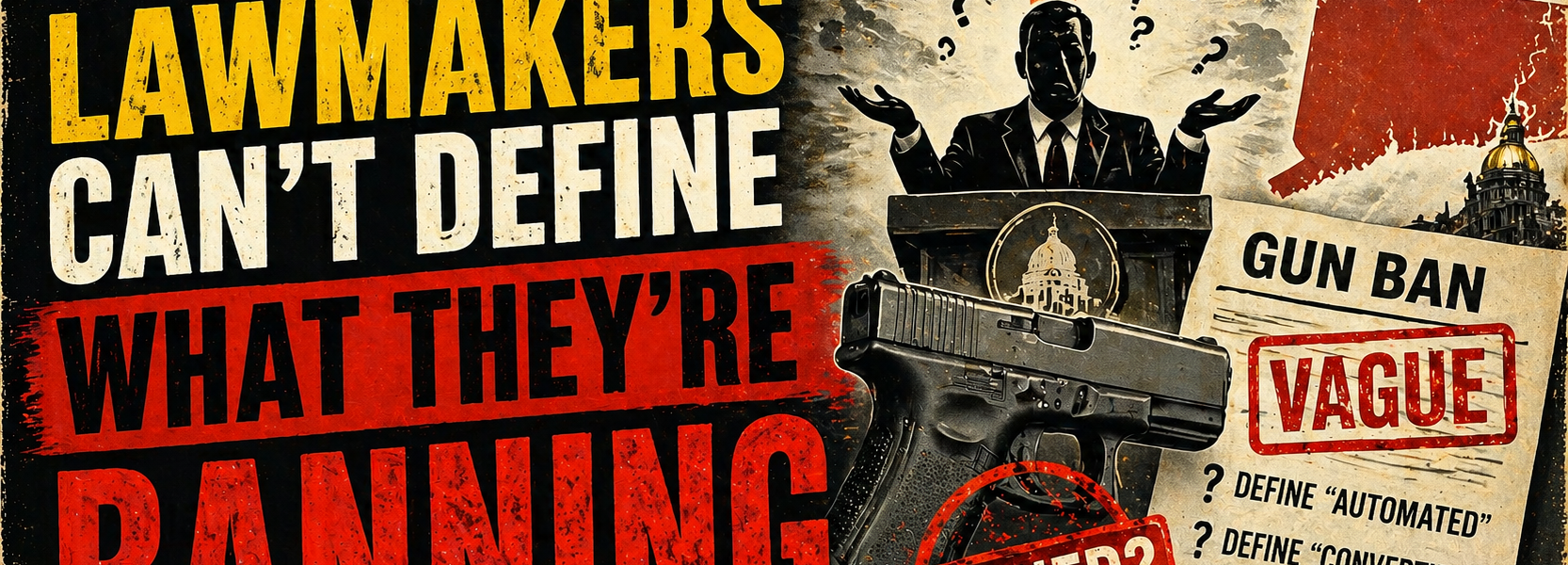
Connecticut state Rep. Bob Godfrey recently defended a bill aimed at banning firearms that are “too easily converted into semi or even fully automated weapons.” The bill, which passed the House 86–64, specifically targets so-called “convertible” pistols, including Glocks and similar designs.
At first glance, that might sound like a narrow, technical concern. But the moment you take a closer look, the logic begins to unravel.
Start with the phrasing.
“Too easily converted.” Compared to what? By whom? Using what tools? There’s no clear standard here, just a vague threshold that could shift depending on who’s defining it. Nearly any mechanical object can be modified with enough time, intent, and illegal parts. That’s not a design flaw. That’s reality.
And then there’s the bigger issue.
Converting a firearm into a fully automatic weapon is already illegal under federal law. Not kind of illegal. Not loosely regulated. Flat-out illegal, with serious penalties attached. So what exactly is this bill trying to solve? A crime that’s already covered, using a justification that’s already addressed.
Instead of focusing on the illegal act, the legislation shifts its attention to the legal object. It’s like banning cars because someone might install illegal modifications later. The responsibility quietly moves away from the person breaking the law and onto everyone who isn’t.
Then comes the most revealing part of the argument.
Godfrey acknowledged that citizens have a right to own firearms for self-defense, but followed that by saying the state can decide which firearms qualify as “defensive weapons.” That’s where things get murky fast. Because once that line is established, it’s no longer about rights. It’s about permissions.
And permissions tend to shrink over time.
What counts as “too convertible” today could easily become “too powerful” tomorrow, and eventually “too unnecessary.” The standard isn’t fixed. It’s flexible. And that flexibility almost always moves in one direction.
Even more telling is the lack of a clear definition for “automated weapons” in Godfrey’s remarks. That’s not a minor oversight. That’s the core of the entire argument. If the terminology driving the legislation isn’t clearly defined, then neither is the scope of what could be banned.
Which leaves gun owners with a simple question.
If a firearm can be banned not for what it is, but for what someone else might illegally turn it into, where does that stop?
Because by that standard, almost nothing does.