
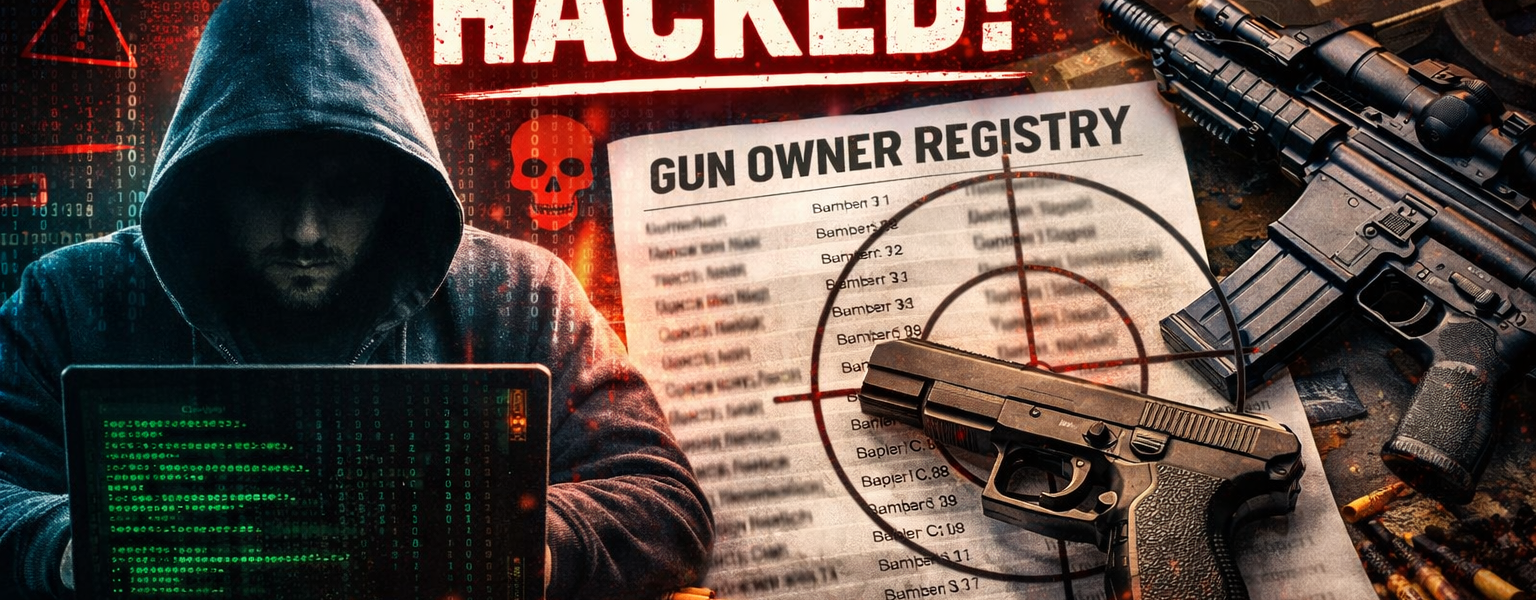
A recent cybersecurity breach in France is once again raising a familiar and uncomfortable question: when governments build registries of law-abiding citizens, who ultimately ends up using that information?
According to reporting from NeuraCyb Cybersecurity, unauthorized actors accessed portions of France’s national firearms database—the Système d’Information sur les Armes (SIA)—a system that requires legal gun owners to register detailed personal and transactional information. The compromised data reportedly includes records tied to roughly 60,000 firearms, with some of that information now allegedly circulating on underground forums.
While officials have stated that the central database itself was not directly hacked, the breach occurred through a compromised account belonging to an authorized third party with legitimate system access. That distinction offers little comfort to those affected. The result is the same: sensitive data, once considered secure, is now potentially in the hands of unknown actors.
A System Built for Oversight—Now Raising New Risks
The SIA system is designed to give French authorities comprehensive visibility into firearm ownership. It includes names, addresses, serial numbers, and transaction histories—essentially a full profile of legal gun ownership across the country.
But the very structure that makes the system useful for tracking also makes it uniquely vulnerable.
Because access to the system is shared among government agencies, licensed professionals, and industry participants, it creates multiple entry points. In this case, investigators believe attackers exploited one of those access points rather than breaching the core infrastructure directly.
That reality underscores a broader issue with large-scale registries: they are only as secure as their weakest access point.
From Data Leak to Real-World Consequences
This is not France’s first experience with firearm registry leaks. Previous incidents have reportedly been linked to targeted home invasions in which criminals used leaked data to identify homes likely to contain firearms.
Security experts warn that this latest breach could pose even greater risks due to the level of detail involved.
When personal identity information is combined with knowledge of firearm ownership, it creates a highly valuable dataset—not just for theft, but for broader criminal exploitation, including fraud, phishing, and identity-based targeting.
Authorities are now advising affected individuals to increase home security, monitor financial activity, and remain alert to suspicious communications.
A Recurring Global Pattern
France is not alone in facing these concerns.
Similar incidents have been reported in countries including Australia, Canada, Israel, and New Zealand. In some cases, data was inadvertently exposed; in others, it was accessed through unauthorized means or even shared beyond its original intended use.
In the United States, state-level systems have also faced scrutiny. California, for example, has experienced its own data exposure issues involving firearm owner information, along with policies allowing certain third-party access for research purposes.
Taken together, these incidents point to a recurring challenge: the more centralized and detailed the data, the more attractive—and potentially vulnerable—it becomes.
The Limits of Compliance-Based Systems
One of the underlying tensions highlighted by the French breach is the nature of registration systems themselves.
They rely almost entirely on compliance from lawful citizens. Those who follow the rules provide accurate, detailed information. Those who do not—by definition—do not appear in the system at all.
This creates an inherent imbalance: databases become rich with information about individuals who are already operating within the law, while offering limited visibility into those who are not.
When such databases are compromised, it is that compliant population that faces the greatest exposure.
Security vs. Accessibility
Defenders of registry systems often argue that stronger cybersecurity measures can mitigate these risks. But modern databases—especially those designed for broad institutional access—are complex environments involving multiple users, integrations, and authentication layers.
Each additional access point increases functionality, but also expands the attack surface.
The French case illustrates how breaches do not always occur through dramatic system failures. Sometimes they result from something far more routine: a compromised login tied to a trusted user.
A Broader Policy Question
As governments continue to balance public safety objectives with individual privacy and security, incidents like this force a difficult reassessment.
How much sensitive information should be centralized?
Who should have access to it?
And what are the real-world consequences when that information is exposed?
These are no longer abstract concerns. They are immediate, practical questions with measurable impacts on the individuals whose data is involved.