For decades, gun control advocates have promised the same thing: pass stricter laws, restrict access to firearms, and crime will fall. It is a simple theory and, politically speaking, a very attractive one. Remove the tool and you remove the violence. The problem is that reality has been far less cooperative with this idea.
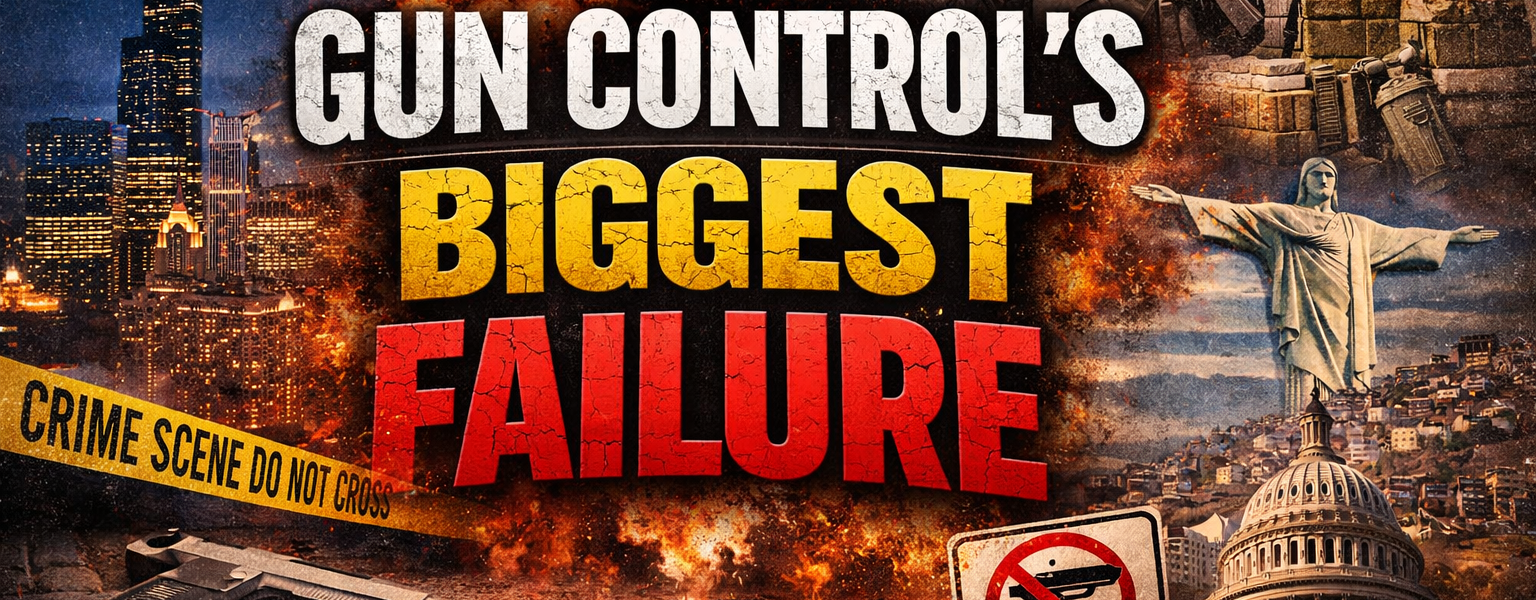
Across the world, governments have repeatedly attempted what might be called the great gun control experiment. The hypothesis was clear: fewer guns equals less crime. But when we look at places that have aggressively pursued this strategy, the results are often far messier than the theory.
Let’s take a tour of a few famous case studies.
Chicago: America’s Strictest Laws, Persistent Violence
Chicago has long been one of the most prominent laboratories for gun control policy in the United States.
For years the city maintained some of the toughest firearm restrictions in the country. Handgun ownership was heavily restricted, gun stores were tightly regulated, and acquiring firearms legally involved a maze of permits and regulations.
Yet despite these laws, Chicago consistently ranks among the cities with the highest levels of gun violence in America.
One of the most common explanations offered by critics of Chicago’s policies is that laws primarily affect people who follow the law. Criminals, meanwhile, often obtain weapons through illegal markets, trafficking networks, or theft.
This has created a paradox frequently cited in debates over gun policy: a city with some of the strictest gun laws also struggling with some of the highest levels of gun crime.
The result has been a long-running national argument over whether Chicago’s experience proves gun laws ineffective or whether the city’s problems stem from broader social and economic factors.
Either way, the original promise of simple solutions has proved elusive.
Washington, D.C.: The Law That Met the Constitution
Washington, D.C. ran its own experiment beginning in the 1970s.
The city enacted one of the most sweeping handgun bans in the United States in 1976. Residents were effectively prohibited from owning handguns, and even legally owned rifles and shotguns had to be kept unloaded and disassembled.
The goal was straightforward: reduce violent crime in the nation’s capital.
But the results did not unfold as policymakers had hoped. During the following decades, Washington, D.C. saw crime rates climb dramatically, eventually earning a reputation in the 1990s as one of the most dangerous cities in America.
The law ultimately met its constitutional reckoning in 2008 with the Supreme Court case District of Columbia v. Heller, which ruled that the Second Amendment protects an individual’s right to possess a firearm for lawful purposes such as self-defense.
The decision struck down the handgun ban and reshaped the national legal landscape surrounding gun ownership.
Brazil: A Rare Policy Reversal
Outside the United States, Brazil provides another interesting chapter in the gun control story.
For years Brazil pursued strict firearm restrictions, including tight regulations on civilian gun ownership. Yet the country continued to struggle with extraordinarily high levels of violent crime.
Eventually public frustration reached a tipping point.
Beginning in 2019, the government moved to loosen restrictions on firearm ownership, allowing more citizens to legally own guns for self-defense. Supporters argued that ordinary people had been left defenseless against heavily armed criminal gangs.
Critics warned that expanding gun ownership could worsen violence.
Brazil’s experience remains the subject of ongoing debate, but it highlights an important reality: countries sometimes reverse gun control policies when citizens lose confidence that those policies are working.
Mexico: Strict Laws, Armed Cartels
Mexico offers one of the most striking examples of the gap between gun laws on paper and violence on the ground.
Mexico has extremely strict firearm laws. Legal gun ownership is tightly controlled, and there is only a single legal gun store in the entire country operated by the military.
In theory, such restrictions should produce a society with relatively few firearms.
In practice, Mexico continues to struggle with severe cartel violence, with criminal organizations heavily armed through black markets and smuggling routes.
The country’s experience illustrates a point frequently raised by critics of gun control: when organized criminal groups operate outside the law entirely, legal restrictions on citizens may have little effect on those actors.
The Complicated Reality
What these examples show is not that gun policy is simple or that any single approach guarantees success.
Rather, they demonstrate that the relationship between firearms and crime is far more complex than many political slogans suggest.
Crime is influenced by numerous factors: economic conditions, policing strategies, cultural norms, drug trafficking networks, organized crime, and social stability. Gun laws exist within that broader ecosystem, and their effects are often difficult to isolate.
The “gun control experiment” has been attempted in many different forms across many places. Sometimes the results appear to support the policy, and sometimes they raise difficult questions.
But one lesson appears consistently: when it comes to crime and public safety, there are rarely easy answers.
And in a debate often dominated by emotion and political rhetoric, those messy realities tend to be the part people like least to talk about.