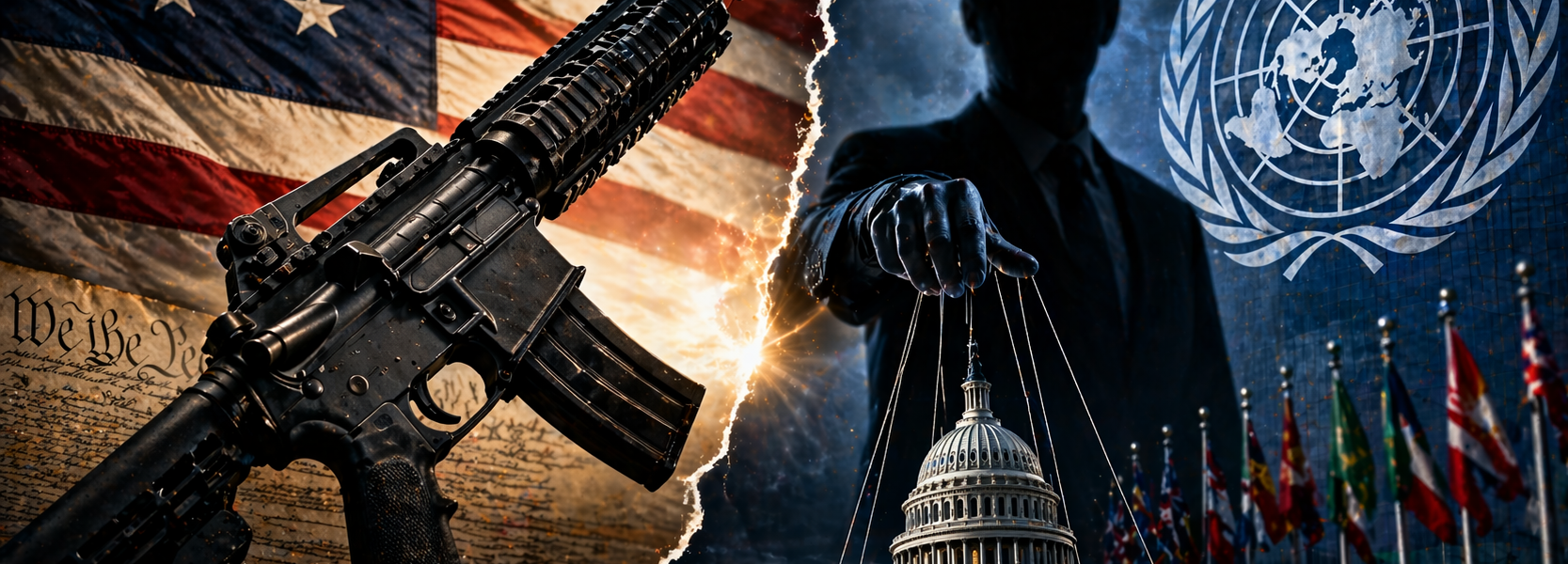
For most Americans, the Second Amendment to the United States Constitution isn’t just a line in an old document. It’s a statement about who holds power in this country.
But step back for a moment, and you’ll notice something unsettling.
The pressure on that right isn’t coming from just one place anymore.
It’s global.
A Different Vision of Control
Across much of the world, civilian gun ownership is not seen as a safeguard—it’s seen as a liability.
International organizations like the United Nations have spent years promoting frameworks aimed at reducing the flow of small arms worldwide. Agreements like the Arms Trade Treaty focus on controlling the transfer of weapons across borders, especially into unstable regions.
On the surface, that sounds reasonable.
Who wouldn’t want fewer weapons ending up in war zones?
But here’s where American gun owners start asking questions: where does “international control” stop—and where does domestic policy begin?
Because ideas have a way of traveling.
When Global Ideas Go Local
Policies don’t appear out of thin air.
They’re influenced by think tanks, international agreements, advocacy groups, and political pressure—often crossing borders long before they reach legislation.
In recent years, critics have pointed to the way global narratives around gun control—particularly those common in Europe and parts of the Commonwealth—have begun shaping conversations in the United States.
The language shifts first:
- “Civilian disarmament” becomes “public safety reform”
- “Restrictions” become “common-sense measures”
- “Control” becomes “coordination”
And gradually, the framing changes.
What was once considered a uniquely American right starts being treated like an international problem to be solved.
The American Exception
Here’s the fundamental tension.
The United States was built on a different premise.
The Second Amendment wasn’t written as a sporting regulation. It was written in the shadow of tyranny—by people who believed that an armed citizenry was a final check against concentrated power.
That idea doesn’t translate easily into global frameworks.
Most countries don’t share that origin story. Most governments don’t want their populations armed in that way. And most international bodies operate from a perspective where stability comes from centralized control—not distributed power.
So when those perspectives meet the American system, friction is inevitable.
Influence Without Borders
Modern influence doesn’t require armies.
It moves through media narratives, policy papers, funding networks, and cultural messaging. It shows up in how issues are framed, how data is presented, and which solutions are considered “acceptable.”
That doesn’t mean every policy debate is driven by foreign actors. But it does mean the conversation is no longer purely domestic.
And for gun owners, that matters.
Because the stakes aren’t just about legislation—they’re about whether the United States continues to define its own principles, or gradually adopts the assumptions of a broader global consensus.
The Quiet Question
At the center of all of this is a simple question that rarely gets asked directly:
Is the right to bear arms a uniquely American safeguard—or a global problem waiting to be managed?
How you answer that question determines everything that follows.
For many gun enthusiasts, the answer is clear.
The Second Amendment isn’t outdated. It isn’t misunderstood. It isn’t in need of international alignment.
It’s a line in the sand.
And in a world where influence flows across borders faster than ever, that line may matter more now than it has in generations.