
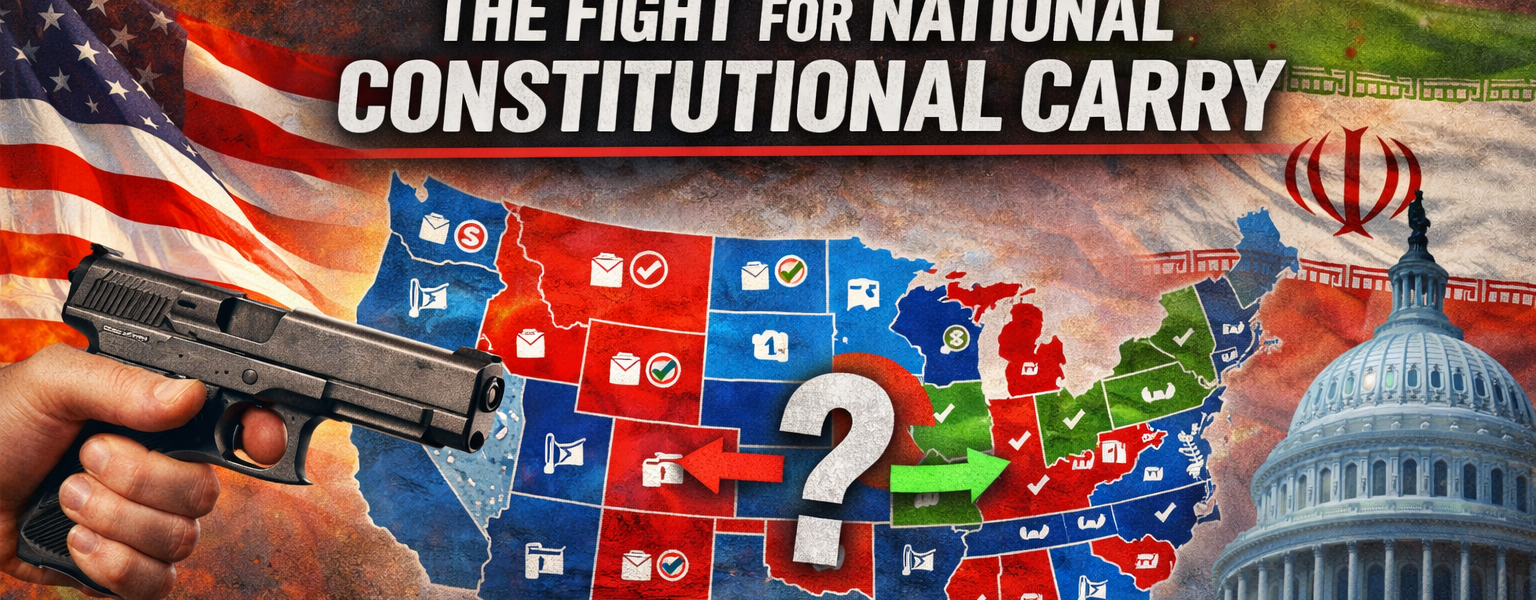
The idea is simple, but the implications are enormous: what if the right to carry a firearm didn’t change the moment you crossed a state line?
That’s the question driving renewed momentum behind national constitutional carry, a proposal that would allow law-abiding Americans to carry across all 50 states without needing permits, fees, or navigating a patchwork of conflicting laws.
For millions of gun owners, this isn’t theoretical. It’s a daily reality.
A Patchwork of Rights
Today, the Second Amendment doesn’t function the same everywhere.
In one state, carrying a firearm may require nothing more than legal eligibility. In another, it could involve:
- Lengthy permit processes
- Mandatory training requirements
- Fees and bureaucratic delays
- Strict “no-carry” zones that shift block by block
Cross into the wrong jurisdiction without knowing the rules, and what was legal minutes ago could suddenly become a felony.
That inconsistency is at the heart of the push for national constitutional carry.
Supporters argue that a constitutional right should not depend on geography.
The Federal Push
Lawmakers backing national constitutional carry say the goal is straightforward: standardize the right to carry across the country.
Rather than forcing gun owners to memorize 50 different legal frameworks, the proposal would:
- Recognize lawful carry nationwide
- Override restrictive state-level barriers
- Eliminate the need for reciprocity agreements
- Treat the right to bear arms similarly to free speech or religious freedom
In this view, the Second Amendment should operate like the First—you don’t lose it when you travel.
The Opposition
Critics see it very differently.
Opponents argue that states have the authority to regulate firearms within their borders and that a national standard would override local control.
They warn that:
- Densely populated states face different risks than rural areas
- Local governments need flexibility to address crime
- A one-size-fits-all approach could weaken existing safeguards
This sets up a familiar constitutional clash: federal authority versus states’ rights.
Courts Already in the Fight
The judiciary is already shaping this battle.
Recent rulings have expanded the interpretation of the Second Amendment, emphasizing that firearm regulations must align with the nation’s historical tradition of gun ownership.
That standard has already led to challenges against:
- Permit requirements
- Magazine limits
- “Sensitive place” restrictions
If national constitutional carry advances, it will almost certainly face immediate legal challenges—potentially landing back in front of the Supreme Court.
Why This Matters Now
This isn’t happening in a vacuum.
Across the country, two opposing trends are accelerating at the same time:
- More states adopting constitutional carry laws
- Other states tightening restrictions on firearms
The result is a widening divide.
For gun owners, that divide creates uncertainty. For lawmakers, it creates pressure to resolve it.
And for the country, it raises a bigger question:
Is the Second Amendment a national right—or a state-by-state privilege?
The Real-World Stakes
This debate isn’t just about legal theory.
It affects:
- Travelers crossing state lines
- Truck drivers and business owners
- Families relocating between states
- Everyday citizens trying to stay within the law
The current system rewards those who can keep up with complex regulations—and punishes those who can’t.
Supporters of national constitutional carry argue that shouldn’t be the case for a constitutional right.
What Comes Next
The push for national constitutional carry is gaining traction, but the road ahead is anything but smooth.
Expect:
- Heated debates in Congress
- Legal challenges from multiple states
- Increased attention from national media
- Potential Supreme Court involvement
No matter the outcome, one thing is clear:
The fight over how—and where—the Second Amendment applies is far from settled.