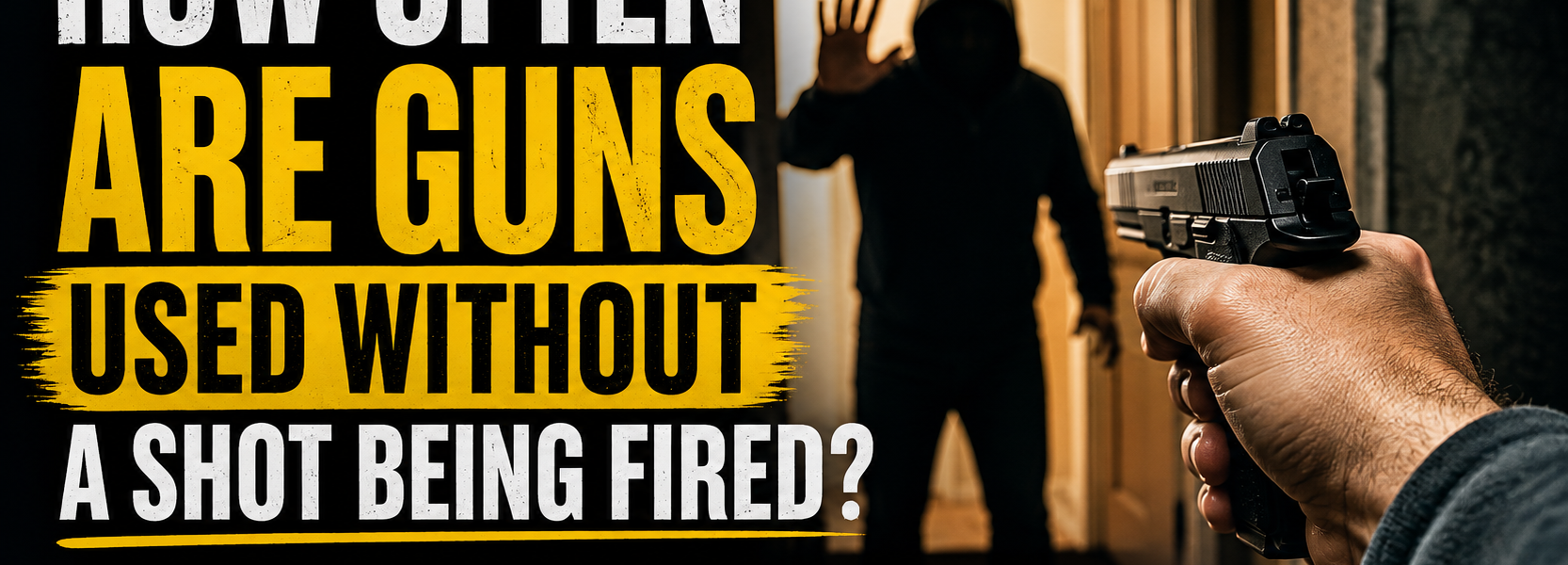
When Americans debate the defensive use of firearms, the conversation often begins with gunfire.
How many attackers were shot? How many criminals were killed? How many armed citizens opened fire?
But those questions may overlook an important part of the story. A firearm does not necessarily have to be fired to be used defensively.
Sometimes the sight of a gun is enough.
Sometimes an armed homeowner confronts an intruder who immediately runs. Sometimes a would-be victim draws a handgun and an aggressor backs away. In other cases, simply telling an attacker that the victim is armed may end the confrontation.
Those incidents are much harder to count than shootings. And that creates one of the biggest problems in America’s debate over defensive gun use.
One Survey Found No Shots Fired in 81.9% of Defensive Uses
One of the more recent large surveys to tackle the question was the 2021 National Firearms Survey, conducted by Georgetown University professor William English.
The survey estimated approximately 1.67 million defensive firearm uses annually among American gun owners. More strikingly, respondents reported that in 81.9% of defensive incidents, the firearm was never fired.
If that estimate accurately reflects the broader population, it suggests something frequently missing from discussions about guns and self-defense: most defensive firearm encounters may end without a bullet leaving the barrel.
The gun itself can serve as the deterrent.
That distinction matters because defensive gun use is sometimes discussed as though it necessarily means shooting someone. It doesn’t.
Researchers have explicitly defined defensive gun use more broadly. A federally sponsored National Survey of Private Ownership of Firearms, for example, asked respondents whether they had used a firearm for protection “even if it was not fired.”
But How Many Defensive Gun Uses Happen?
This is where things become complicated.
There is no universally accepted number.
Estimates of defensive gun use have differed enormously depending on how researchers collect the information and define an incident.
Older Bureau of Justice Statistics data found that from 1987 through 1992, an average of roughly 62,000 violent-crime victims per year reported using a firearm in an attempt to defend themselves. Another roughly 20,000 victims annually used guns while attempting to protect property from theft, burglary or vehicle theft.
A newer analysis of National Crime Victimization Survey data covering 1987 through 2021 similarly estimated roughly 61,000 to 65,000 defensive firearm incidents per year across different periods. For 2016 through 2021, researchers estimated an average of about 65,219 annually.
Compare that with the 2021 National Firearms Survey’s estimate of 1.67 million per year, and the disagreement becomes obvious.
We’re not talking about a minor statistical difference. We’re talking about estimates that can differ by more than an order of magnitude.
Why Is There Such a Huge Disagreement?
Part of the answer may be found in the very question we’re asking.
Imagine someone tries to force his way into a home. The homeowner retrieves a handgun and tells the intruder he is armed. The intruder sees the weapon and runs.
Nobody is shot.
Perhaps nobody calls the police.
Was that a defensive gun use?
The homeowner would probably say yes. A crime survey may never record it at all.
Different surveys also ask different questions, sample different populations and rely on respondents accurately remembering and characterizing events.
There is another problem going in the opposite direction: surveys can potentially produce false positives. When researchers are trying to measure a relatively rare event across hundreds of millions of people, even a small number of respondents misunderstanding a question or exaggerating an experience can dramatically inflate a national estimate.
A Justice Department report examining an earlier national firearms survey actually warned that its own survey-based estimates appeared implausibly high and suggested the estimates could be overstated by an order of magnitude or more.
That’s why presenting any single defensive-gun-use estimate as indisputable fact is difficult to justify.
The Missing Category in the Gun Debate
But the uncertainty surrounding the total number doesn’t make non-shooting defensive uses irrelevant.
Quite the opposite.
They reveal a limitation in one of the most common ways Americans talk about firearms.
If we look only at shootings, homicides and wounded attackers, we are measuring situations in which a firearm was actually discharged. We aren’t necessarily measuring every situation in which possession of a firearm changed someone’s behavior.
Consider what successful deterrence looks like.
The criminal leaves.
The homeowner doesn’t fire.
Nobody goes to the hospital.
The incident may never become a news story.
And unless it is reported to police or captured by a survey, researchers may never know it happened.
That makes deterrence inherently difficult to measure.
Defensive Gun Use Doesn’t Always Look Like Hollywood
Popular culture has conditioned people to think of armed self-defense as a dramatic shootout.
Real-world defensive firearm encounters can be much less dramatic.
A firearm can potentially function as a defensive tool simply because the aggressor knows it is there.
That doesn’t establish that every claimed defensive gun use was lawful, necessary or beneficial. Researchers have debated those questions as well, and defensive firearm use remains one of the most contested areas of gun research.
But it does establish an important distinction.
Using a gun and firing a gun are not synonymous.
And if the 2021 National Firearms Survey is anywhere close to correct about the proportion of defensive incidents involving no gunfire, that distinction isn’t marginal. It describes the overwhelming majority of the defensive uses reported in that survey.
The Number We May Never Know
So how often do Americans stop crimes with firearms without firing them?
The most accurate answer is that we don’t know with precision.
Depending on the methodology, estimates for defensive firearm use overall range dramatically. That disagreement should be acknowledged rather than hidden.
But there is substantial reason to recognize a category of defensive gun use that receives relatively little attention: confrontations that end without a shot.
For supporters of the Second Amendment, that’s an important point.
The value of possessing a firearm for self-defense cannot necessarily be measured solely by counting how many times Americans pull the trigger.
Sometimes the outcome the gun owner wants most is the one in which nobody has to.