A deadly shooting at Old Dominion University has reignited a national debate—not just about violence, but about how institutions respond to it, what factors are ignored, and who ultimately bears responsibility.
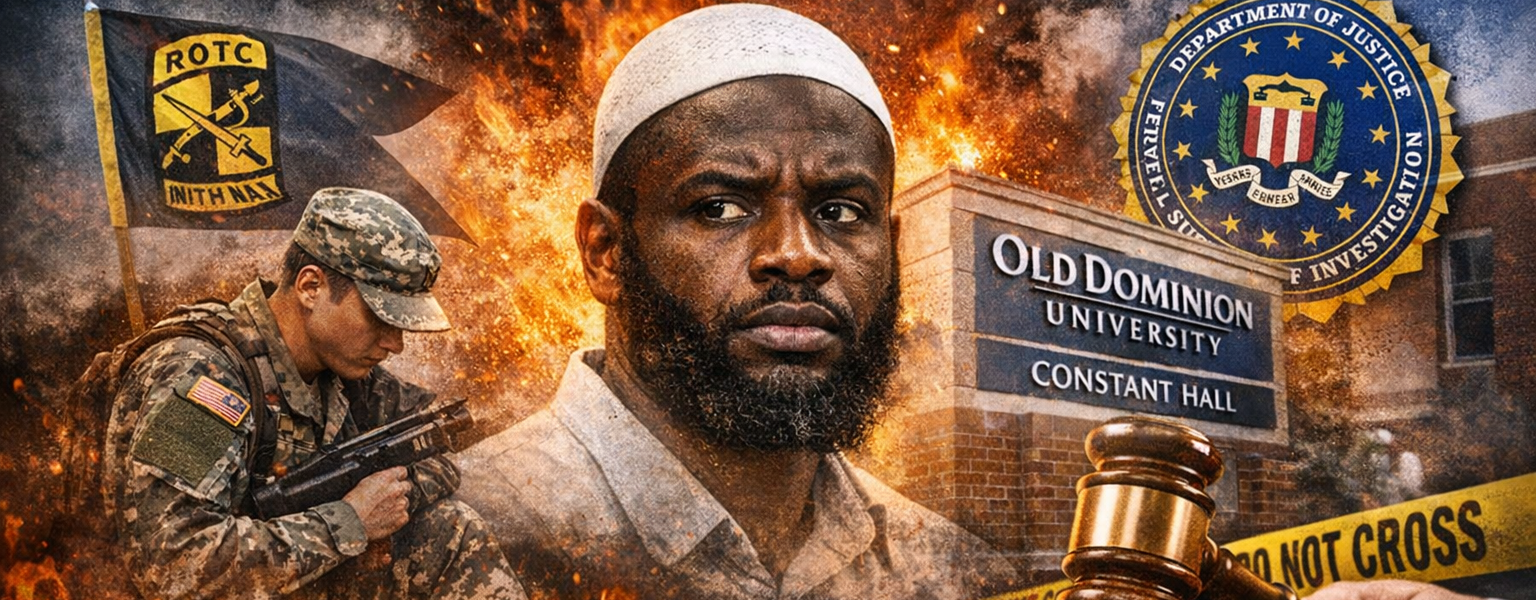
The attack, now under FBI investigation as an act of terrorism, left a professor dead and two ROTC cadets wounded after a gunman opened fire inside a classroom on campus.
But beyond the immediate tragedy, the circumstances surrounding the suspect—and the system that handled him—are drawing increasing scrutiny.
A Targeted Attack
According to reports, the suspect entered a classroom in ODU’s Constant Hall on March 12 and specifically asked whether the class was affiliated with ROTC. When confirmed, he allegedly shouted a religious phrase before opening fire on the instructor, Lt. Colonel Brandon Shah, killing him and injuring two students.
The attack ended only after students in the room intervened and subdued the suspect, stopping what could have become a far more deadly incident.
A Troubling Background
The suspect’s history raises serious questions about how he was able to carry out the attack in the first place.
He had previously pleaded guilty in 2017 to providing material support to ISIS and was sentenced to 11 years in prison—yet was released more than two years early in late 2024.
Prosecutors had originally sought a significantly longer sentence, citing concerns that he intended to carry out a mass-casualty attack. Still, the court opted for leniency, citing mitigating factors including his personal background and prior service.
After his release, he was allowed to return to college—ultimately enrolling at the very institution where the attack would later occur.
Less than 18 months later, he allegedly carried out the shooting.
The Weapon and Missed Warnings
The firearm used in the attack was not obtained legally.
Authorities have linked the weapon to an individual previously investigated for illegal gun sales. Despite prior scrutiny from federal authorities, that individual was not prosecuted and instead received a warning.
That decision is now being revisited in light of the role the weapon played in the attack.
The sequence of events—prior terrorism charges, early release, access to a weapon through illegal channels—has led critics to argue that multiple systemic failures aligned to make the tragedy possible.
Competing Narratives
In the aftermath, public officials have emphasized broader societal issues, including gun policy, as central to understanding the attack.
During a press conference, Norfolk Commonwealth’s Attorney Ramin Fatehi spoke about what he described as a “national sickness,” placing focus on gun culture and political will.
Others argue that such framing overlooks critical elements of the case, including the suspect’s prior conviction, ideological motivations, and the decisions made by the justice system leading up to his release.
The result is a familiar divide—one that often emerges after high-profile acts of violence—over whether to focus on tools, motives, or institutional responsibility.
Civilian Response
One point of agreement is how the attack ended.
The incident was stopped not by law enforcement, but by individuals on the scene. ROTC cadets intervened and neutralized the attacker during the confrontation, preventing further casualties.
Their actions likely saved lives.
That reality has renewed discussion about preparedness, response time, and the role of individuals in active threat situations—especially in environments where certain defensive measures may be restricted.
A Broader Pattern?
The ODU attack did not occur in isolation.
On the same day, another violent incident targeting a synagogue in Michigan was also stopped when armed security confronted the attacker.
In both cases, the immediate response came from individuals on-site, not external intervention.
These parallel events have fueled a broader conversation about how threats are addressed in real time—and whether current policies adequately reflect those realities.
The Bottom Line
The tragedy at Old Dominion University raises more questions than it answers.
How did an individual with a prior terrorism conviction return to civilian life so quickly? Why were earlier warning signs not acted upon more decisively? And what lessons, if any, will be drawn from the convergence of failures that preceded the attack?
As investigations continue, the focus will likely remain divided between competing explanations.
But for many, the central issue is clear: when systems fail at multiple levels, the consequences are measured in lives lost—and the cost of ignoring those failures only grows.