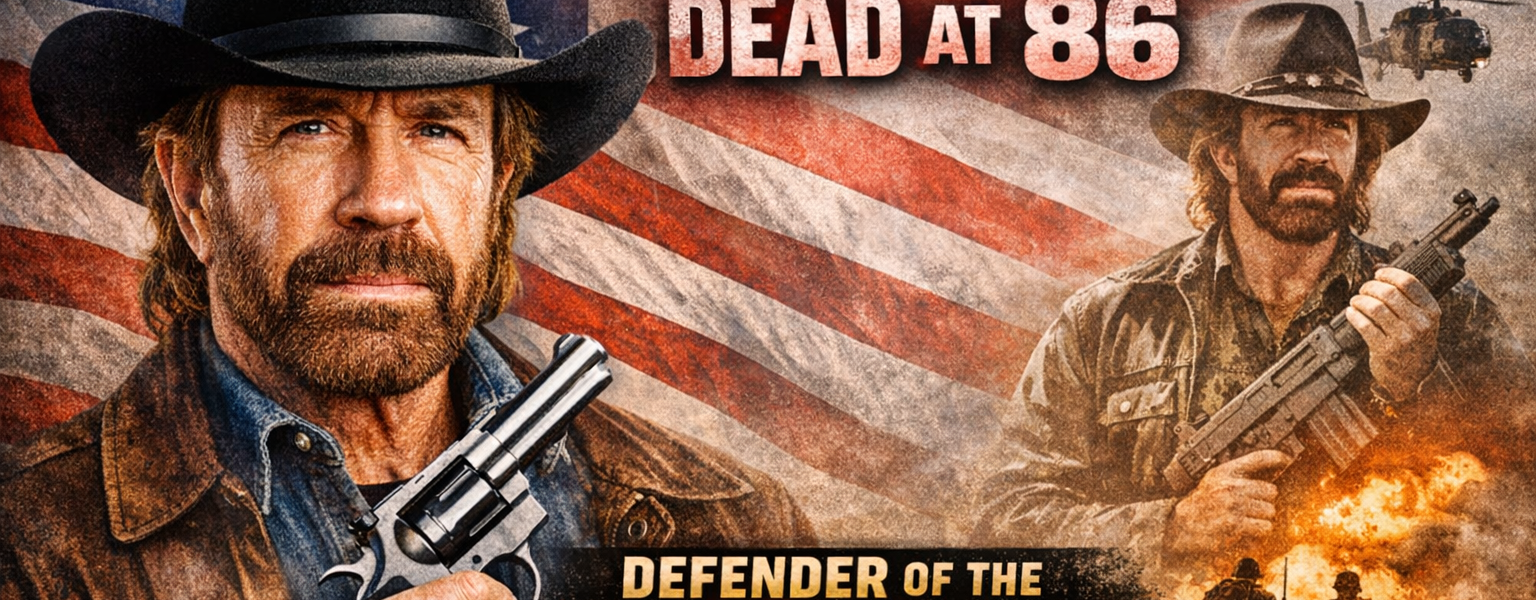
Chuck Norris was never just a movie star. He was something far rarer in modern America—a cultural figure who didn’t retreat from his beliefs when the spotlight got brighter. With his passing at 86, the country loses not only an action legend, but one of the most recognizable and unapologetic advocates for the Second Amendment in recent decades.
Born Carlos Ray Norris in 1940, his journey from a quiet, reserved young man to a global icon began in the U.S. Air Force, where he first studied martial arts. That discipline would define his life, carrying him through a decorated competitive career and into Hollywood, where his on-screen persona became synonymous with justice, strength, and moral clarity.
But Norris’ legacy cannot be understood through film alone.
As his career evolved, so did his public voice. And unlike many in entertainment, Norris didn’t drift with the cultural current—he pushed against it. Nowhere was that more evident than in his outspoken defense of the Second Amendment.
For Norris, gun ownership was never about politics in the shallow, partisan sense. It was about responsibility, self-defense, and the preservation of liberty. He consistently framed the right to bear arms as inseparable from the broader architecture of American freedom—a safeguard, not just a privilege.
That conviction led him into a long-standing partnership with the NRA, where he became one of the most visible celebrity advocates for gun rights in the country. He wasn’t a passive supporter lending his name for appearances. He actively campaigned, spoke, and mobilized.
In 2010, addressing NRA members in Charlotte, Norris delivered a message that cut straight to the core of his worldview: the Constitution, he warned, was under pressure—and rights only survive when citizens are willing to defend them, both culturally and politically.
That message became a cornerstone of his advocacy.
Through the NRA Freedom Action Foundation’s “Trigger the Vote” campaign, Norris pushed a simple but urgent idea: gun owners must also be voters. Rights, he argued, are not self-executing. They require participation. They require vigilance. And above all, they require a citizenry willing to act before those rights are eroded.
This wasn’t theoretical for Norris. It was personal.
Much of his film career—especially in movies like Delta Force and Missing in Action—reflected a worldview shaped by service, sacrifice, and a belief in American sovereignty. His younger brother’s death in Vietnam only deepened that connection. The themes he portrayed on screen—defending the vulnerable, confronting threats head-on, and standing firm in the face of danger—mirrored the principles he later defended in real life.
Even his most famous television role, Walker: Texas Ranger, reinforced those ideas. His character wasn’t just enforcing the law—he represented a moral framework where good and evil were distinguishable, and where strength was used to protect, not dominate.
That clarity carried over into his public commentary.
Norris frequently warned against what he saw as a gradual cultural drift away from self-reliance and constitutional understanding. In his view, the erosion of the Second Amendment wasn’t just about firearms—it was about weakening the individual’s role in a free society.
And yet, he consistently emphasized peaceful engagement.
Unlike the caricatures often painted by critics, Norris advocated for political action, civic involvement, and education—not chaos. He urged Americans to vote, to stay informed, and to engage the system rather than abandon it. His message was firm, but disciplined—much like the martial arts philosophy that shaped his life.
Beyond politics, Norris also invested heavily in the next generation through his Kickstart Kids Foundation, teaching young people the values he believed were essential to a functioning society: discipline, responsibility, courage, and respect.
In later years, Norris became an internet phenomenon through the viral “Chuck Norris facts”—a series of exaggerated, often absurd tributes to his toughness. He embraced the humor, but never lost sight of what he believed truly defined him: faith, family, and a commitment to enduring principles.
And that’s what ultimately sets his legacy apart.
Chuck Norris didn’t just play the role of a strong man. He spent decades arguing that strength—properly understood—meant responsibility. It meant protecting others. It meant standing for something, even when it wasn’t popular.
In a cultural moment where many public figures avoid conviction, Norris leaned into it.
He understood that rights are not preserved by accident. They are preserved by people willing to defend them—clearly, consistently, and without apology.
That was Chuck Norris.
And in that sense, his legacy may prove more enduring than any role he ever played.