For years, critics warned that Canada’s sweeping gun ban and confiscation program would become a bureaucratic nightmare. Now, with the government’s own numbers coming into focus, those warnings look less like speculation and more like prophecy.
Canada’s lawful gun owners are approaching the end of the federal government’s “declaration period” for its Assault-Style Firearms Compensation Program, the scheme designed to collect firearms banned under Ottawa’s sweeping gun prohibition. Owners have until March 31 to declare their now-prohibited firearms and file claims for compensation.
But there’s a catch.
Public Safety Canada has warned that while declarations make owners “eligible” for compensation and collection, payment itself is not guaranteed. Claims, the department says, will only be accepted “based on availability of program funds.”
That phrase raises an obvious question: Where exactly has the money gone?
A Program Already Three Times Over Budget
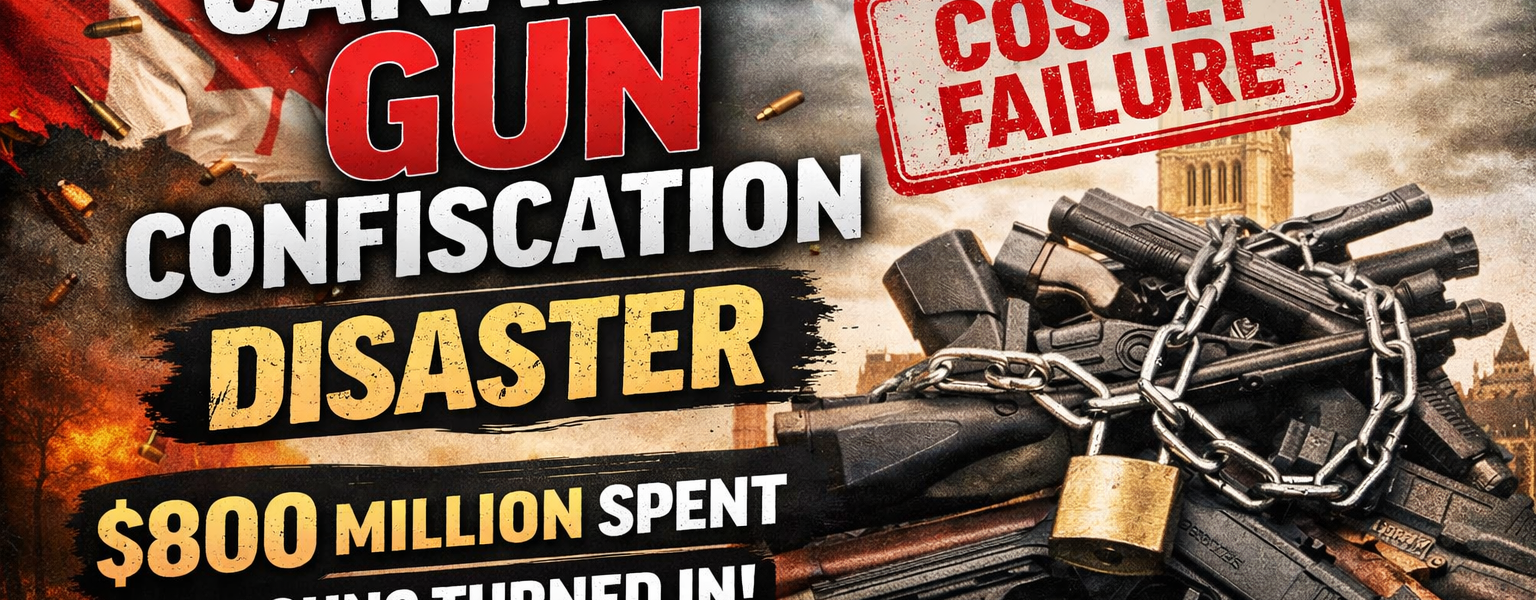
Five years ago, the Liberal government estimated the gun confiscation scheme would cost roughly CAD$250 million. Even then, skeptics predicted the number would balloon, recalling Canada’s infamous long-gun registry, which started with a modest $2 million estimate and ultimately devoured $2.7 billion in taxpayer funds.
The early signs suggest history is repeating itself.
According to Daniel Fritter of the Canadian firearms publication Calibre, government figures show that as of early 2026 the program has already consumed about CAD$779.8 million. That is more than three times the original estimate—and the program has barely begun collecting guns.
Even more astonishing is the cost per firearm surrendered.
Government documents indicate that taxpayers are currently spending roughly CAD$25,000 for every firearm collected or surrendered.
Yet the government’s own compensation schedule intends to pay owners an average of only about CAD$1,800 per gun. Early participants in the pilot phase reportedly received closer to CAD$700 per firearm.
In other words, the administrative machinery of the confiscation program is costing taxpayers more than twenty thousand dollars per gun—often thirty times more than the owner receives in compensation.
The Numbers Get Worse
Those figures may actually understate the real cost.
Fritter notes that the documented spending does not include the expenses of more than a dozen partner agencies involved in running the program. When those costs are eventually tallied, the real price tag will almost certainly climb even higher.
And for all that spending, participation remains vanishingly small.
Estimates suggest only between 1.6 percent and 6 percent of newly prohibited firearms have been declared by their owners.
In other words, after nearly six years of planning, legislation, and hundreds of millions in spending, well over 90 percent of the targeted firearms remain outside the program.
Police Don’t Want the Job
Even many law enforcement agencies appear reluctant to participate.
The Ottawa Police Service recently stated that it cannot take on the program’s additional responsibilities without harming core policing duties.
Meanwhile, Alberta and Saskatchewan have reportedly informed the Royal Canadian Mounted Police that any expenses related to the gun confiscation program will be deducted from provincial policing contracts.
The message is clear: even the institutions tasked with enforcing the program are wary of its cost and complexity.
A Question of Priorities
The scale of spending is especially striking when compared to real public safety budgets.
According to reporting in Canada’s National Post, the nearly $780 million already spent on the confiscation scheme exceeds the entire annual operating budget of the Vancouver Police Department. It would cover almost the full budget of Montreal’s police service or roughly half the annual cost of running Toronto’s police force.
Put another way, the federal government is spending the equivalent of a police officer’s starting salary for every three firearms surrendered.
Two confiscated guns could purchase a fully equipped patrol vehicle.
Yet the program targets firearms owned overwhelmingly by licensed citizens who had previously complied with Canadian law.
A Familiar Pattern
For Canadians who remember the long-gun registry fiasco, the pattern is painfully familiar: optimistic cost projections, ballooning administrative expenses, and stubborn political commitment long after the policy’s flaws become obvious.
Rather than acknowledge the program’s spiraling cost and limited results, the government appears trapped in the sunk-cost fallacy—continuing to pour resources into a failing policy simply because so much has already been spent.
Six years after the gun ban began, Canada’s confiscation effort increasingly looks less like a public safety initiative and more like one of the most expensive bureaucratic misadventures in recent Canadian history.
For observers both inside and outside Canada, the lesson may be difficult to ignore: when governments attempt massive gun control schemes, the result is often not safer streets—but staggering costs, administrative chaos, and very little to show for it.