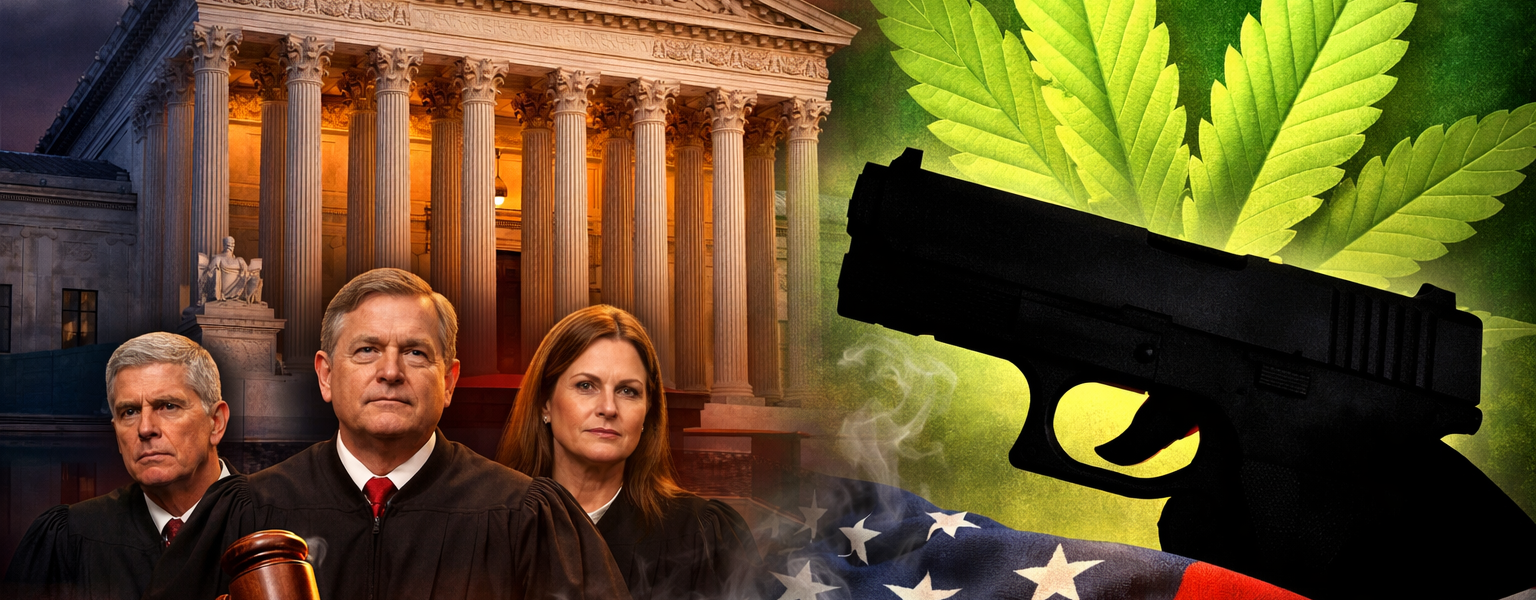
The U.S. Supreme Court is weighing a Second Amendment case that could reshape how federal law treats gun ownership for people who use marijuana. During oral arguments this week in U.S. v. Hemani, several justices expressed skepticism about the government’s authority to broadly ban firearm possession for individuals labeled “habitual” marijuana users.
At issue is 18 U.S.C. § 922(g)(3), a federal statute that makes it a felony for anyone who is an “unlawful user of or addicted to any controlled substance” to possess a firearm. The law has been on the books for decades, but its application has drawn renewed scrutiny as cannabis legalization has spread across the country.
With marijuana now legal in some form in roughly 40 states, the Court’s questioning reflected a growing tension between federal gun law and changing state-level cannabis policies.
The Case: U.S. v. Hemani
The case centers on Ali Danial Hemani, a Texas resident whose home was searched by federal agents in 2022 as part of a broader investigation. Agents discovered a legally purchased Glock 9mm pistol, along with about 60 grams of marijuana and 4.7 grams of cocaine.
Hemani admitted he smoked marijuana roughly every other day. He was never accused of using drugs while armed, but federal prosecutors charged him under the statute banning firearm possession by unlawful drug users. If convicted, he could face up to 15 years in prison.
A federal appeals court dismissed the indictment, ruling the law was unconstitutional as applied to him. The Justice Department then appealed to the Supreme Court.
Justices Question the Definition of “Drug User”
Several justices appeared uneasy about how broadly the federal government defines a “drug user.”
Justice Neil Gorsuch pressed government attorneys on whether occasional cannabis use could justify permanently stripping someone of their gun rights.
“We don’t even know the quantity,” Gorsuch said during arguments. “What if he took one THC gummy with a medical prescription to help him sleep every other day? Disarm him for life?”
Justice Amy Coney Barrett also questioned whether Congress had actually determined that marijuana use inherently makes someone more dangerous.
“With marijuana, I just don’t see anything in the statutory scheme that reflects Congress’s judgment that this makes someone more dangerous,” Barrett said.
Their concerns highlight a central legal issue in the case: whether simply being a marijuana user, without evidence of dangerous behavior, is enough to justify disarmament under the Constitution.
Roberts Emphasizes Congress’s Authority
Not all the justices were ready to dismiss the law.
Chief Justice John Roberts emphasized that marijuana remains classified as a controlled substance under federal law, regardless of how individual states regulate it.
Roberts suggested that courts should be cautious about overriding Congress’s policy judgments.
“There’s a broad range of determinations like that where we leave the question of its addictive difficulties and consequences to the legislature,” Roberts said.
The comment signals that the Court may look for a narrow ruling rather than completely striking down the statute.
Bruen Precedent Looms Over the Case
The Court’s analysis will likely hinge on its landmark 2022 decision in New York State Rifle & Pistol Association v. Bruen, which dramatically expanded Second Amendment protections.
In that ruling, the Court held that modern gun restrictions must be consistent with the historical traditions of firearm regulation in early American history.
That test has already led lower courts to strike down several federal and state gun laws, including restrictions on certain firearm accessories and age-based purchasing limits.
The Hemani case asks whether historical precedent supports disarming people based on substance use.
During arguments, Gorsuch questioned whether colonial-era laws targeting “habitual drunkards” truly support modern restrictions on marijuana users.
He even pointed out that some of the Founding Fathers were known to drink heavily.
“Thomas Jefferson said he wasn’t much of a drinker,” Gorsuch said, “only three or four glasses of wine a night.”
Government: Mixing Guns and Drugs Is Dangerous
The Justice Department argued the law fits within a longstanding tradition of restricting firearm access for people considered potentially dangerous.
Government attorney Sarah Harris told the Court that the statute is a temporary restriction tied to active drug use.
“The Second Amendment does not prohibit the government from temporarily disarming habitual marijuana users while they persist in frequent use,” Harris argued.
The government says allowing drug users to possess firearms increases the risk of violence and impaired judgment.
Unusual Political Alliances
The case has produced an unusual lineup of allies on both sides.
Supporting Hemani are groups that rarely align politically, including:
-
National Rifle Association
-
Gun Owners of America
-
American Civil Liberties Union
-
Drug Policy Alliance
All argue the law is overly broad and violates constitutional rights.
Supporting the federal government are 19 states, mostly led by Democratic attorneys general, along with gun control advocacy group Brady Center to Prevent Gun Violence.
The Hunter Biden Connection
The same statute played a central role in the high-profile prosecution of Hunter Biden, who was convicted under Section 922(g)(3) for possessing a firearm while using illegal drugs.
That case helped bring national attention to the rarely enforced provision.
A ruling that limits or overturns the law could have implications for similar prosecutions in the future.
A Narrow Decision Likely
Based on the tone of the oral arguments, the Court appears unlikely to issue a sweeping ruling.
Instead, the justices may craft a narrow decision focused specifically on marijuana users who do not pose an immediate danger.
Such a ruling could leave the broader statute intact while limiting how aggressively prosecutors can apply it.
The Court is expected to issue its decision by early summer.
If the justices side with Hemani, the ruling could mark another major shift in the ongoing legal battle over how far the government can go in restricting gun ownership under the Second Amendment.