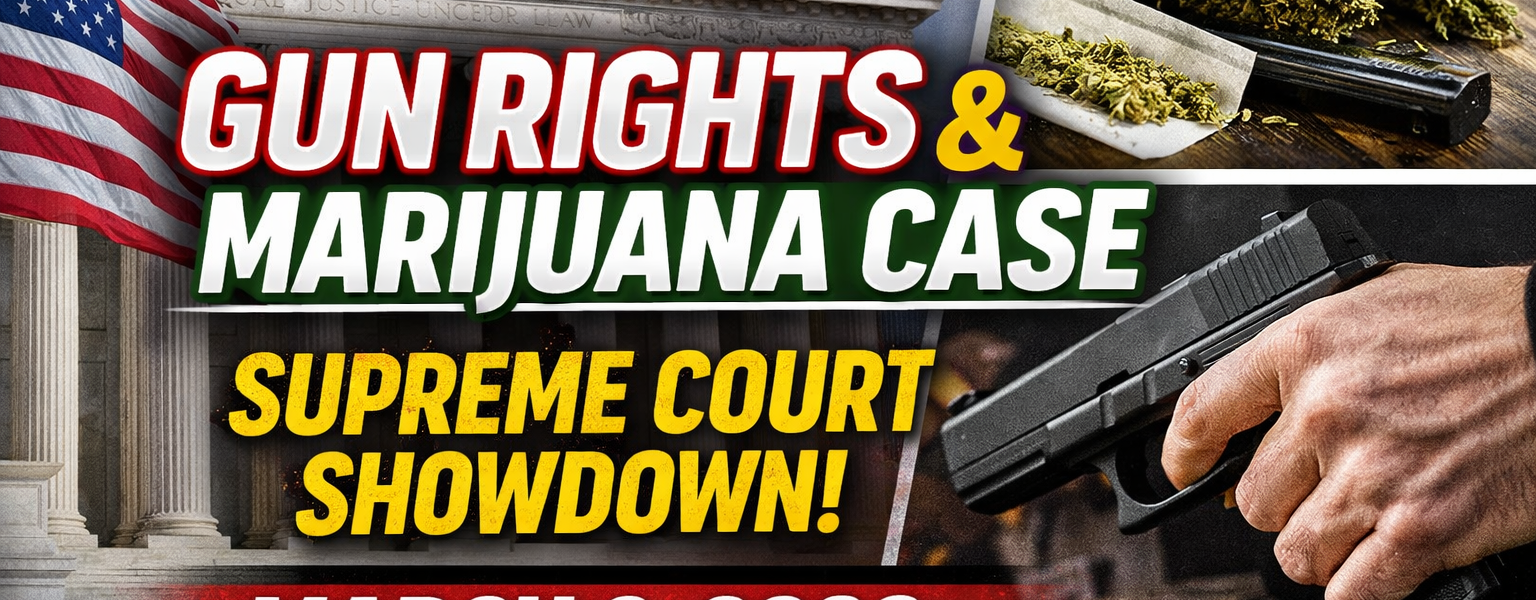
The U.S. Supreme Court has officially set oral arguments for March 2, 2026 in a landmark Second Amendment case that could reshape federal gun rights law for millions of Americans. The dispute centers on whether the federal government may prohibit people who use marijuana or other controlled substances from purchasing or possessing firearms under 18 U.S.C. § 922(g)(3). Marijuana Moment
What the Case Is About
At issue is a long-standing federal gun prohibition that makes it illegal for anyone who is an “unlawful user of or addicted to any controlled substance” to possess firearms. This rule has been in place since the Gun Control Act of 1968, but its constitutionality under the Second Amendment has been increasingly challenged in federal courts. JD Supra
The specific case, United States v. Hemani, involves a Texas man arrested after law enforcement found marijuana and a firearm in his home. Lower courts — including the Fifth Circuit — held that applying § 922(g)(3) to people who use marijuana (but are not necessarily dangerous at the moment of possession) violates the Second Amendment, especially after the Supreme Court’s recent Bruen framework, which demands firearms regulations align with historical traditions of gun control. JD Supra
Why This Matters
If the Supreme Court upholds the federal ban:
-
Federal restrictions on gun ownership for marijuana users will remain intact and could be cited to uphold similar prohibitions.
-
Millions of Americans who both use cannabis (legal in many states) and own firearms could continue to face criminal penalties. AP News
If the Court strikes down the ban:
-
It could significantly broaden Second Amendment protections.
-
Lower court rulings invalidating § 922(g)(3) in other circuits may gain legal force nationwide.
-
Federal and state marijuana users could gain full firearm rights so long as they are not otherwise disqualified under federal law. Marijuana Moment
Arguments and Positions
Government (DOJ):
The Justice Department has defended § 922(g)(3), asserting that people who use illegal drugs pose heightened safety concerns that justify disarmament. Marijuana Moment
Gun Rights Advocates:
Supporters of expanded gun rights argue that the law is inconsistent with the Second Amendment as interpreted in New York State Rifle & Pistol Association v. Bruen (which requires firearms restrictions to have historical analogues). They say there is no clear historical tradition of disarming people simply for drug use, especially when not intoxicated at the moment of gun possession. JD Supra
Several federal appeals courts — including the Fifth and Eighth Circuits — have already ruled that such bans are unconstitutional as applied to marijuana users. These decisions underline the constitutional tension driving the Supreme Court’s review. Marijuana Moment
Political & Policy Context
The case comes amid broader debates about federal marijuana policy and gun control. Some Republican lawmakers have questioned why alcohol users (who can legally purchase guns) are treated differently from marijuana users, highlighting perceived inconsistencies in federal law. AOL
Additionally, recent federal policy shifts around marijuana scheduling could intersect with how courts view drug-related prohibitions, though the precise legal effects are still uncertain. Marijuana Moment
What to Watch Next
-
Oral arguments March 2, 2026: Expect robust questioning on how to apply Bruen’s history-and-tradition test to modern federal gun restrictions.
-
Decision timing: A ruling will likely come by late June or early July 2026, just before the Court’s term ends.
-
Broader 2A impact: This case could become one of the most significant Second Amendment decisions since Bruen, influencing lower courts and federal enforcement of gun laws for years. JD