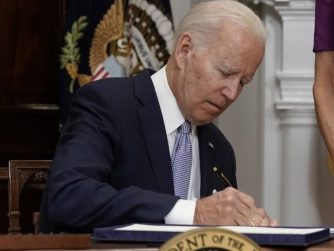

In a historic move tied to President Donald J. Trump’s Executive Order on the Second Amendment, the U.S. Department of Justice has announced the creation of a new Second Amendment Section within its Civil Rights Division—the first DOJ unit ever dedicated specifically to defending the constitutional right to keep and bear arms.
Led by Acting Chief Andrew Darlington, the new section’s mandate is explicit: protect the firearm rights of law-abiding Americans. According to DOJ materials, the unit will investigate law-enforcement agencies that engage in patterns or practices that infringe on Second Amendment rights, while proactively pursuing litigation to secure those rights nationwide. That includes filing statements of interest, motions to intervene, amicus briefs, and original lawsuits to advance a broad, constitutionally grounded interpretation of the Second Amendment. The DOJ has also provided contact information and a reporting mechanism for alleged violations.
Assistant Attorney General Harmeet K. Dhillon, who heads the Civil Rights Division, described the initiative as long overdue. In a video announcing the launch, Dhillon emphasized that the Second Amendment is not a “second-class right” and said she has been working to establish the section since arriving at the Department. For the first time, she noted, the DOJ’s civil rights apparatus will actively protect and advance Americans’ right to bear arms.
Dhillon outlined early enforcement priorities, including jurisdictions that impose multi-thousand-dollar fees to obtain concealed carry permits, impose unreasonably long processing delays, or ban firearms that Supreme Court precedent has made clear are constitutionally protected. States, she said plainly, cannot interfere with the right of law-abiding citizens to carry commonly used firearms.
She also framed the Second Amendment as a practical and equalizing civil right. Armed citizens deter crime, Dhillon argued, and firearm ownership enables women, people with disabilities, and others who may be more vulnerable to defend themselves. The Founders, she added—through the Federalist Papers and other founding documents—clearly understood the right to bear arms as an individual right for lawful purposes.
“Stay tuned,” Dhillon concluded. “You’re going to see a lot more action from this Department of Justice to protect your Second Amendment rights.”
In a separate interview with NEWSMAX, Dhillon voiced support for national concealed-carry reciprocity, calling it a matter of basic consistency. She cited her own experience navigating conflicting permit rules in the Washington, D.C. region and described the patchwork of state firearm laws as unnecessary and illogical—particularly when other areas of law already recognize reciprocity across jurisdictions.
Gun-control organizations reacted with predictable hostility. Brady issued a statement condemning the new section, warning that it would “endanger gun violence prevention laws,” while simultaneously insisting that its favored policies are fully consistent with the Second Amendment. If that claim is accurate, the group should have little to fear from constitutional scrutiny.
Notably, Brady previously applauded aggressive executive action on gun control under the Biden-Harris administration and openly touted its role in shaping those policies, including the creation of the White House Office of Gun Violence Prevention. The contrast highlights a familiar pattern: executive power is acceptable when it restricts gun rights, but objectionable when it protects them.
The DOJ’s move is not occurring in isolation. At the federal level, the Department of Education has awarded nearly $1 million to the University of Wyoming’s Firearms Research Center to develop a nationwide program offering secondary-school teachers nonpartisan, historically grounded instruction on the origins, legal interpretation, and civic meaning of the Second Amendment. The program is intended to mark America’s 250th anniversary by engaging educators with the nation’s founding documents and the evolving role of the right to bear arms in American civic life—without the ideological framing that has long dominated the topic.
Skepticism toward federal promises is warranted. History gives Americans plenty of reason to reserve judgment until enforcement matches rhetoric. Still, the creation of a dedicated Second Amendment Section within the DOJ’s Civil Rights Division represents a sharp break from the recent past. At minimum, it signals a fundamental shift in how the federal government understands the right to keep and bear arms—not as a regulatory inconvenience, but as a core civil right deserving of active protection.