Earlier this year, President Donald Trump issued an Executive Order addressing “politicized or unlawful debanking” and the misuse of so-called “reputational risk” by financial institutions to deny services based on a customer’s political or religious beliefs, or lawful business activities disfavored for political reasons.
The order, Guaranteeing Fair Banking for All Americans, formally establishes the principle that no American should be denied access to financial services because of constitutionally or statutorily protected beliefs, affiliations, or political views. It further directs that banking decisions must be based on individualized, objective, and risk-based assessments, rather than being used as tools to suppress lawful beliefs or activities.
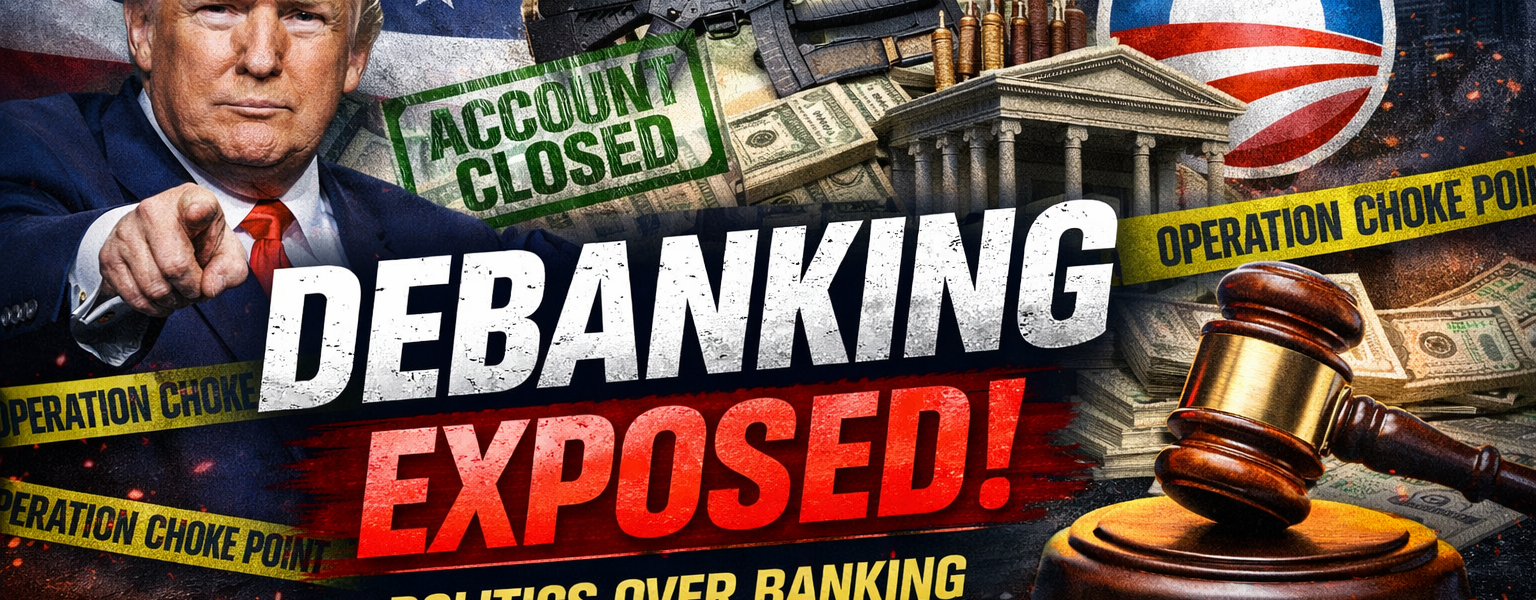
The Executive Order explicitly references “Operation Choke Point,” a program initiated under President Barack Obama in which the Department of Justice and the Federal Deposit Insurance Corporation weaponized “reputational risk” to pressure banks into cutting off financial services to certain disfavored but lawful industries, including licensed firearm and ammunition dealers. Under Choke Point, regulators coerced banks to deny credit and banking access to businesses labeled “high risk,” despite the absence of fraud or legal violations. Notably, while the administration pressured banks to sever ties with lawful industries, it simultaneously issued guidance facilitating banking services for the marijuana industry.
By 2014, the U.S. House Committee on Oversight and Government Reform concluded that the Justice Department lacked adequate legal authority for Operation Choke Point. In 2017, the DOJ confirmed that all related investigations had ended and that the initiative would not resume. During the first Trump administration, the Office of the Comptroller of the Currency finalized a “fair access” rule requiring banks to evaluate customers using neutral, quantitative, risk-based standards rather than excluding entire categories of lawful businesses. That rule was placed on hold under the Biden administration, during which debanking reportedly not only resumed but intensified.
On October 7, the OCC and FDIC issued a proposed rule to formally eliminate “reputation risk” from their supervisory frameworks. The proposal would prohibit regulators from directing or encouraging banks to close accounts, deny services, or modify relationships based on political, social, cultural, or religious beliefs, constitutionally protected speech, or lawful but politically disfavored business activities. Public comment on the proposed rule closes on December 29, 2025.
In parallel, the OCC initiated a review of the nine largest national banks under its supervision—JPMorgan Chase, Bank of America, Citibank, Wells Fargo, U.S. Bank, Capital One, PNC Bank, TD Bank, and BMO Bank—to determine whether customers were debanked or discriminated against based on political or religious beliefs or lawful business activities. The review covers multiple industries, including firearms and firearms-related businesses, fossil fuel production, tobacco and e-cigarettes, political organizations, and digital asset activities.
Preliminary findings released on December 10 revealed that between 2020 and 2023, all nine banks maintained policies that resulted in discriminatory treatment of lawful businesses. Several banks restricted services to entire industries or imposed heightened review requirements based on political or reputational considerations. One bank flagged industries subject to heightened activist or political scrutiny, while another restricted clients engaged in activities it deemed contrary to its institutional values, despite their legality.
Regarding firearms manufacturers, retailers, and distributors, the OCC found that several banks restricted financing for companies offering certain firearms or accessories, including so-called assault-style weapons, bump stocks, and high-capacity magazines. Some banks cited polarized public opinion on gun rights and gun control, while others claimed associations with firearm businesses posed franchise or reputational risk. In some cases, banks conditioned relationships on compliance with their own interpretations of firearm “best practices.”
Additional instances of improper debanking are expected as the OCC’s review continues. The agency is currently examining nearly 100,000 consumer complaints and thousands of documents spanning 2020 through 2025. According to the OCC, banks will be held accountable going forward, and unlawful debanking will not be allowed to continue. Further findings will be released as the review progresses.